
Protecting Your Belongings During a Move: Your 2027 Guide to MoveProtect and Liability Cover

Worrying about how to protect your belongings during a house move?
Most of us spend weeks or even months thinking about dates, costs, and boxes, yet very little time on the question that matters most if something goes wrong: who is responsible for your things while they are on the road, at sea or in storage?
Protecting your belongings during a move is far easier when you understand the cover in place well before your removals team arrives, rather than leaving it to the very last minute or worse, discovering the gaps afterwards.
At White & Company, we no longer sell insurance policies directly following changes in insurance regulation. Instead, we offer MoveProtect, a contractual liability solution designed to make your level of protection clear from the outset.
This refreshed 2027 guide walks you through how it works, whether you are moving across town, to the Channel Islands, or to the other side of the world.
A Short Overview of This Blog
Here is a quick summary of everything this guide covers, so you can jump straight to the part that matters most for your move. Each point below matches a section of the article.
- What Is MoveProtect and Why Does It Matter in 2027? How declaring a value for your goods sets our level of liability while your belongings are in our care.
- Limited Liability Explained. The standard £40 per item cap that applies automatically if you choose not to opt in.
- What Does MoveProtect Cover? The duty of care we accept during loading, transit, unloading, and storage, plus the usual exclusions.
- MoveProtect or Limited Liability: Which Is Right for You? A side-by-side look at the two options and who each one suits.
- Packing Your Own Boxes? Read This First. Why self-packed items are treated differently and how professional packing protects your cover.
- Will My Home Insurance Cover My Move? The questions to ask your insurer before you rely on an existing policy.
- Protecting Your Belongings on an Overseas or Channel Islands Move. Why international and island moves carry extra risks, and how MoveProtect fits alongside marine cover.
- What Happens If Something Goes Wrong? Your claims route and the independent dispute resolution available through BAR membership.
- Talk to White & Company About Your Move. How to arrange MoveProtect as part of your free survey.
- Frequently Asked Questions About Moving Home. Quick answers to five common moving home questions.
Understanding your options early means fewer surprises later. Read on for the full details on each point.
What Is MoveProtect and Why Does It Matter in 2027?
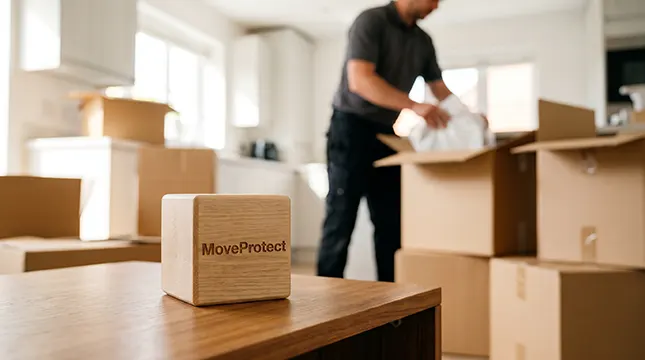
White & Company’s MoveProtect is a contractual liability solution that allows customers to declare the maximum replacement value of their belongings, establishing the company’s liability for loss or damage during a move.
MoveProtect is a contractual liability solution, not an insurance policy.
Before your move, you declare a Maximum Replacement Value for your goods, and this figure sets the level of our liability for loss or damage while your belongings are in our care.
A few key points to know:
- Your cover reflects real value. Opting in means our liability is based on the value you declare, not a flat rate per item.
- The charge is proportional. The MoveProtect charge, which is subject to VAT, is calculated in line with your declared value.
- Your no claims discount is safe. Claims are handled by specialist adjusters and sit outside your own home insurance, so your personal no claims discount is unaffected.
MoveProtect complies with FCA regulations and is approved under the British Association of Removers framework, giving you a clear, regulated alternative to buying a separate policy.
Limited Liability Explained
If you decide not to opt in to MoveProtect, your goods are still covered, but only under our standard Limited Liability terms.
Under Limited Liability, we are liable for up to £40 per item for loss or damage caused by our negligence. That is usually fine for a box of saucepans, but it rarely reflects the true replacement cost of a sofa, a television, an antique dresser, or a much loved family heirloom.
Think of it this way: if a £1,200 wardrobe were damaged beyond repair, Limited Liability would cap our payout at £40.
Declaring a realistic value through MoveProtect closes that gap.
What Does MoveProtect Cover?
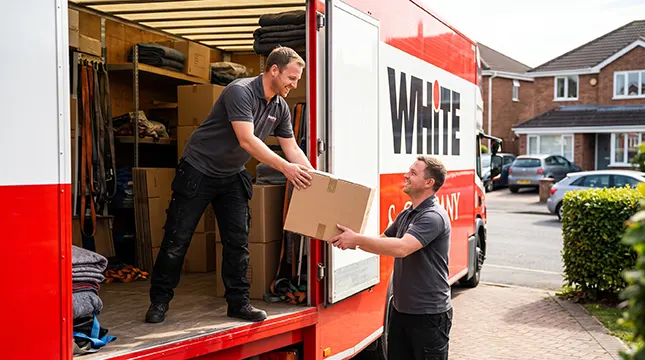
MoveProtect provides contractual liability protection for belongings in White & Company’s care, including loading, transportation, unloading and secure storage, subject to the terms and exclusions of the agreement.
Under MoveProtect, we accept a duty of care for your belongings for as long as they are in our custody. This generally includes:
- Loss or damage during loading, transport and unloading.
- Loss or damage while your goods are held in our secure storage
- Loss or damage resulting from any failure on our part to meet our duty of care.
As with any liability agreement, there are sensible exclusions, such as extreme weather events and pre-existing wear and damage.
These follow standard industry practice, and we always recommend reading the Special Importance Conditions in your contract so there are no surprises.
MoveProtect or Limited Liability: Which Is Right for You?
The right choice depends on what you are moving and how much it would cost to replace.
- Limited Liability is the default if you do nothing. It costs nothing extra, but cover is capped at £40 per item, whatever the item is worth.
- MoveProtect increases our liability up to the value you declare. The charge is linked to that value, and any claims excess is paid by us rather than you.
If your household includes quality furniture, electricals, artwork, or items with sentimental value, MoveProtect is usually the more sensible route.
When you arrange your pre-move survey, our surveyor can talk you through a realistic valuation during your visit.
Packing Your Own Boxes? Read This First

Professional packing can play an important role in protecting belongings during a move, with White & Company’s MoveProtect terms distinguishing between professionally packed and owner-packed items.
Packing yourself can feel like a smart way to save money, but it has a direct effect on your protection.
Items you pack yourself are covered at the standard Limited Liability rate of £40 per item, even if you have taken out MoveProtect. Full MoveProtect cover applies when you opt in and your belongings are packed by our trained team.
If you want the best protection for fragile or valuable pieces, our professional packing service is well worth considering.
If you do plan to pack some boxes yourself, our 48 packing tips will help you do it safely, and our guide to packing for export covers the extra care needed for an overseas shipment.
NOTE: Professional packing supports accurate documentation, suitable protection, and compliance with destination requirements; whether owner-packed goods are accepted depends on the destination, shipping service, and insurance terms.
Will My Home Insurance Cover My Move?

Home contents insurance does not always cover belongings during professional removals or storage, so checking your existing policy and understanding MoveProtect can help identify potential gaps in protection.
Possibly, but never assume.
Some home contents policies may include cover for goods in transit, but details vary widely between insurers, and storage or overseas moves are often excluded altogether.
Before moving day, pick up the phone and ask your insurer:
- Are my belongings covered while in transit with a professional remover?
- Is storage included, and if so, for how long?
- Are fragile items covered if I pack them myself?
- Do high-value items need to be declared separately?
Independent guidance from Which? and Compare the Market can help you understand the small print before you make the call.
If your policy leaves gaps, MoveProtect provides a straightforward extra layer of protection built around the removals process.
Protecting Your Belongings on an Overseas or Channel Islands Move

International removals and moves to Jersey or Guernsey involve additional handling and transportation stages, making it important to understand MoveProtect, marine liability and the protection available for belongings travelling overseas.
A move abroad adds new stages to your belongings’ journey. Your goods may be transferred into a container, wait at a port for a sailing slot, spend weeks at sea and pass through customs in another country before they reach your new home.
Each extra stage brings a little more risk, which is why protection for international shipments has traditionally been known as marine insurance.
Our in-depth guide, What is MoveProtect? How Marine Insurance Works for Your International Move, explains how MoveProtect relates to traditional marine cover and how to value your shipment.
You can also explore our full international removals service for destinations worldwide.
Island moves deserve a special mention too. Moving to or from Jersey relies on ferry schedules, tides, and customs paperwork, as Jersey sits outside the UK VAT area.
Our guide on how to choose a removals company in Jersey covers the questions to ask, and the Government of Jersey sets out the rules on bringing household items to the island.
Our Jersey removals team handles the customs documentation for you.
What Happens If Something Goes Wrong?
Even with the most careful team, accidents can happen.
If an item is lost or damaged, contact your White & Company branch as soon as possible so the claims process can begin promptly.
As long-standing members of the British Association of Removers (BAR), we use approved MoveProtect contracts and follow the BAR Code of Practice.
If a claim cannot be resolved directly between us, you have access to independent alternative dispute resolution through the Dispute Resolution Ombudsman, which works with trade bodies including BAR.
That is one of the many reasons to look for the BAR badge when comparing quotes.
Our article on why a BAR registered removals company can make your move a success explains the wider benefits, and our list of questions to ask a removals company will help you compare firms with confidence.
Talk to White & Company About Your Move

With more than 150 years of experience, White & Company has helped generations of families move safely, locally, nationally, and internationally.
Protecting your belongings during a move begins with a conversation.
MoveProtect is discussed as part of your free, no-obligation removals survey, where your surveyor will help you arrive at a realistic, declared value and answer any questions specific to your move. Prefer to speak to someone local?
Find your nearest team using our branch locator or contact us today.
MoveProtect is a contractual liability solution offered by White & Company, approved by the BAR and compliant with FCA regulations. It is not an insurance product.
Frequently Asked Questions About Moving Home
How far in advance should I book a removals company?
For most UK house moves, aim to book around four to eight weeks ahead, and longer for summer, Fridays, month ends or international moves, when dates fill quickly. Our guide on how far in advance to book a removals company has a month-by-month planning timeline.
What should I keep with me on moving day?
Pack an essentials bag with keys, phone chargers, medication, important documents, toiletries, a change of clothes, snacks, and the kettle. Valuables such as jewellery and cash are best kept with you rather than on the removal’s vehicle.
Who do I need to tell when I move house?
Start with your bank, employer, GP, dentist, council tax office, utility suppliers, insurers, DVLA and any subscriptions. Setting up a Royal Mail redirection is a useful safety net for anything you forget. Our moving checklist helps you keep track.
When should I arrange insurance for my new home?
If you are buying, buildings insurance usually needs to be in place from exchange of contracts, as you become responsible for the property then and most mortgage lenders require it. Contents cover should start from the day you move in.
Is it cheaper to move house midweek?
Often, yes. Fridays and the end of the month are the busiest days for completions, so a Tuesday, Wednesday or Thursday move can offer better availability and, in some cases, better value. It is always worth asking your removals company about flexible dates.

Max is a seasoned writer and blogger in the real estate and home moving sectors, as well as a knowledgeable source of information for expatriates living and working abroad. His detailed insights have helped thousands of people move and live abroad with greater simplicity and ease.

Posted in: News
Leave a Comment (0) ↓