


Moving Home in Summer: How to Plan a Stress-Free Move in the UK’s Busiest Season

There is something undeniably hopeful about moving home in summer that UK families dream of.
The longer days, the sense of a fresh start, the very real possibility of unpacking boxes in actual sunshine rather than the usual British drizzle. It feels, in theory, like the ideal time to begin again.
In practice, of course, a warm-weather relocation is also one of the most competitive, diary-squeezing exercises you will ever attempt.
Removal vans get booked up months in advance, conveyancers are stretched to capacity, and every family in your postcode seems to have settled on the same Friday.
The good news is that with the right preparation, a summer move can be genuinely brilliant.
This guide is here to help you plan smarter, move calmer, and start your next chapter on the right foot, with no frantic last-minute scrambling anywhere in sight.
Quick Summer Moving Guide (At a Glance)
Plan ahead, book early, and stay flexible to keep your summer move on track.
- Why Summer Moves Peak – School holidays and better weather drive demand.
- Book Early – Secure your removal company 8–12 weeks ahead.
- Plan Your Timeline – Break tasks into clear weekly stages.
- Protect in Heat – Keep fragile and heat-sensitive items safe.
- Choose Smarter Dates – Midweek and early July reduce pressure.
- Use Storage if Needed – Bridge gaps between completion dates.
- Moving with Kids & Pets – Plan support to reduce stress.
- Long Distance & Overseas – Allow extra time for logistics.
- Moving Day Essentials – Stay organised and keep key items close.
- Settling In – Focus on basics first and explore your new area.
A well-timed plan turns a hectic summer move into a smooth, fresh start.
Why Summer is the UK’s Runaway Favourite Moving Season

With school holidays and the promise of better weather, it’s no surprise that nearly a third of all UK moves happen during the summer months.
Before diving into the practicalities, it is worth understanding why summer has become so dominant in the UK moving calendar.
The season is not popular by accident, and knowing the reasons helps you plan around the pressures it creates.
Research from HomeOwners Alliance confirms that August is consistently the most popular month to move home in the UK, accounting for around 12% of all annual moves.
July and September follow closely behind. Taken together, nearly a third of all residential moves in the country happen within a ten-week window.
The reasons are almost always the same. School holidays allow families to relocate without uprooting children mid-term.
Spring viewings and accepted offers naturally translate into summer completions once the legal process has run its course.
And the prospect of a winter move, with short days and icy pavements, holds very little appeal for most households.
For families in particular, timing a move to coincide with the school summer break is simply logical. Children can settle into a new home, get to know their new surroundings, and build a little confidence before the autumn term begins.
That makes the planning your move stage absolutely critical, because when everyone else has the same idea, early organisation becomes the thing that separates a smooth move from a chaotic one.
The Golden Rule: Book Your Removal Firm Earlier Than You Think

Secure your BAR-accredited removal company 8 to 12 weeks in advance to avoid disappointment during the frantic summer peak.
If there is one piece of advice worth printing out and pinning somewhere visible, it is this: your removal company should be among the very first calls you make after an offer is accepted, not one of the last.
During peak summer weeks, reputable removal firms can be fully booked six to eight weeks ahead of schedule.
Friday dates, chosen by around 29% of all movers according to industry data, disappear the fastest of all. The last Friday in August is perennially the single busiest moving day in the UK, with tens of thousands of households completing on precisely the same date.
Booking late does not just risk disappointment. It can force you into an awkward midweek date that does not suit your chain or push you towards a less experienced operator simply because that is all that remains available.
A video survey is an excellent way to secure an accurate, no-obligation quote without waiting for a home visit. It is particularly useful if you are juggling work, childcare, and the general upheaval of preparing a property for sale.
At White & Company, video surveys can be arranged quickly, giving you a firm quote and a provisionally reserved date without unnecessary delay.
Building a Summer Moving Timeline That Actually Works

Break your moving admin down into manageable weekly stages to keep the stress at bay as moving day approaches.
Generic moving checklists can feel somewhat detached from reality. A summer relocation has its own particular rhythm, and your timeline needs to reflect that.
Here is a practical breakdown of what to tackle and when.
Eight to Ten Weeks Before
Confirm your removal firm and provisionally reserve your preferred date as soon as possible. Begin gathering packing materials and work through the house room by room, setting aside anything you no longer need.
Charity shops tend to get busy in summer too, so it pays to donate early rather than leaving it to the last week.
If children are moving with you, notify their current school of the intended moving date and start researching schools in the new area.
The Gov.uk school admissions page is the most reliable starting point for in-year applications and will walk you through the process step by step.
Four to Six Weeks Before
Redirect your post via Royal Mail’s address redirection service, ideally for a minimum of six months, to catch anything that slips through. Notify your bank, GP surgery, DVLA, HMRC, and all utility suppliers of your forthcoming change of address.
Begin packing non-essential items at this stage, including books, out-of-season clothing, and any kitchen equipment you use only occasionally. If you are using White & Company’s professional packing service, confirm the dates with your allocated team now so everyone is aligned on timing.
One to Two Weeks Before
If you are doing a DIY move, pack the majority of the house, labelling every box clearly by room and general contents. This single habit saves considerable time at the other end, as your removal team can place boxes directly into the correct rooms rather than leaving everything in the hallway.
Prepare a dedicated essentials box for moving day itself: a kettle and mugs, phone chargers, a change of clothes for everyone, children’s comfort items, and any medications that need to be immediately accessible.
Confirm your expected completion time with your solicitor and removal team, and have a sensible contingency plan in case keys run later than anticipated.
Beating the Heat: Looking After Your Belongings on a Warm Moving Day

From warping vinyl records to sensitive electronics, learn how to keep your belongings and your removal crew safe when the temperatures rise.
Sunshine is a welcome companion on moving day, but a British summer can also deliver surprisingly high temperatures inside a removal van, and not everything appreciates the warmth in the way you might.
Certain categories of belongings require special thought during a hot-weather move:
- Candles, vinyl records, and anything containing wax or resin can warp or soften if left inside a warm vehicle for an extended period.
- Electronics are also sensitive to temperature extremes, so laptops, tablets, and gaming equipment are best kept with you in the car where possible.
- Potted plants need ventilation and should never be sealed inside airtight boxes.
Hydration is easily overlooked on a busy moving day, but it matters considerably.
Moving is hard physical work at the best of times, and a hot day makes it considerably harder for everyone involved.
Keep cold drinks readily available for yourself and, just as importantly, for the removal crew doing the heavy lifting on your behalf.
A well-looked-after team works more efficiently, and the gesture is always appreciated.
If your move day coincides with a heatwave, consider agreeing an earlier start time with your removal company. Completing the loading before midday means tackling the most physically demanding part of the day during the cooler morning hours, leaving the afternoon for the lighter work of unpacking, and settling in.
You can explore White & Company’s full range of packing solutions to ensure your belongings are properly protected from the elements, whatever the weather brings.
Thinking Outside the Peak: Clever Date Strategy for Summer Movers
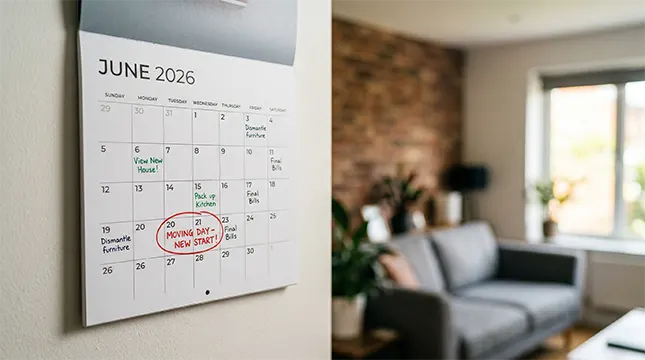
Avoid the dreaded late-August Friday rush by opting for a quieter midweek or early-July completion date.
There is a genuine case to be made for swimming slightly against the summer tide.
While July and August are undeniably peak season, not every date within those months carries the same level of demand, and small adjustments to your moving date can make a meaningful difference to cost, availability, and general stress levels.
Fridays attract a noticeable premium during summer, simply because demand is at its highest.
If your chain can accommodate a Tuesday or Wednesday completion, you are likely to find removal firms more available, more competitively priced, and operating with considerably less of the frantic energy that tends to build on a high-demand Friday.
Midweek movers also sidestep the bank holiday traffic surges that accompany late August weekends.
Early July can be noticeably quieter than the second half of August.
Many families delay until August because the school holidays feel more fully underway by then, but moving in the first two weeks of July gives you all the practical advantages of a summer relocation, longer daylight hours, warm weather, children not in school, without quite as much competition for vans, solicitors, and removal dates.
If a long-distance relocation is part of your plan, White & Company’s long distance removal service covers the length and breadth of the UK.
Our teams plan routes carefully to avoid peak-day congestion, so your move arrives on time regardless of how busy the roads happen to be.
When Your Dates Do Not Quite Line Up: The Case for Summer Storage

If your property chain is delayed by summer conveyancing backlogs, secure containerised storage provides vital breathing room.
In a perfect world, you would hand over one set of keys and collect another on the very same morning.
In practice, gaps and overlaps are far more common than most people anticipate, and in summer, when chains are longer and conveyancers are under greater pressure, they are more likely still.
If your sale completes before your purchase does, or if you are downsizing and need a little breathing space to decide what stays and what goes, short-term storage is a genuinely useful tool rather than a measure of last resort.
The same applies if you are renting temporarily between properties or relocating overseas and are not yet certain of your final destination.
White & Company offers secure storage solutions at locations across the UK, with flexible terms designed to suit both short bridging periods and longer-term requirements.
Belongings are held in clean, monitored facilities, giving you the peace of mind to focus on the legal side of things while your possessions are looked after properly.
Moving with Children and Pets During the School Holidays

Keep the kids involved with simple tasks and arrange safe spaces for your pets to ensure a smooth, tear-free moving day.
The summer holidays might appear to be the ideal window for a family move, and in many ways they genuinely are, but moving with children adds another level of stress.
Having children at home rather than at school removes one significant logistical pressure. But the absence of a school run does not automatically mean the absence of complications.
Children who are old enough to participate can be given a real sense of ownership over the process.
A labelled box they have packed themselves, a small task to complete, a role to play on moving day, all of these things help children feel involved rather than swept along by events that are happening to them.
Younger children, however, need close supervision at a time when adults are understandably distracted by a hundred other things.
Arranging for a grandparent, trusted friend, or childminder to have young ones for the day itself is often the kindest solution for everyone, including the children, who will find the whole thing considerably less unsettling when they are not watching their home being dismantled around them.
Pets also deserve equal thought. Dogs can become anxious around strangers moving furniture in and out of the house. Cats are notorious escape artists whenever a front door is left propped open.
Arranging for animals to stay with someone familiar on move day or confining them safely to a single room with clear signage for the removal team, avoids a great deal of unnecessary stress for everyone.
The RSPCA’s guide to moving home with pets has practical, straightforward advice well worth reading before your move day arrives.
Summer Moves Beyond Borders: Going Long Distance or Overseas

Planning an international summer move? You will need to start your customs paperwork and shipping prep at least three months in advance.
For those relocating significantly further afield, whether to another part of the UK or to an entirely new country, summer is equally popular as a window for the move.
The logistics involved, however, require considerably more lead time than a straightforward local relocation.
European (particularly since Brexit) and international removals involve customs documentation, specialist packing for export, coordination across time zones, and, in some cases, quarantine considerations for certain destinations.
None of this is beyond reach, but it does need to start earlier. If you are planning an overseas summer move, aim to have your removal company confirmed and briefed at least three months before your intended departure date.
White & Company has extensive experience in European removals and international moving, with dedicated teams who understand the particular requirements of each destination country.
Whether you are heading to France, Australia, Spain or South Africa, their teams have made the journey many times before and know precisely what each route demands.
On the Day: Keeping Everything Moving, Literally
Moving day has a kind of organised chaos to it, regardless of how well you have prepared in advance. A few practical habits, established before the van arrives, can make all the difference between a day that flows smoothly and one that stalls at every turn.
Completion time, the point at which funds transfer, and keys formally change hands, can occur at almost any point during the working day and is rarely predictable down to the hour.
Try to finish all your packing the evening before so that the removal team can begin loading as early as possible. This builds useful buffer time into the day and avoids the frustrating scenario where a van sits idle on a warm road while everyone waits for a solicitor to return a call.
Make sure you:
- Keep important documents with you throughout the day rather than having them loaded inadvertently into the removal van.
- Passports, mortgage paperwork, insurance documents, and any contracts should travel in your own car.
- Before you leave your old property for the last time, take photographs of each room as a record of its condition.
- Take a note of the readings on all utility meters.
- At your new home take the meter readings there.
- Take a quick walk through every room before unloading begins, so that boxes can be directed to the correct places from the outset rather than gathering in a pile in the hallway.
These things may seem obvious, but when removal day gets chaotic, it’s a great reminder so that you don’t forget anything.
The First Week in Your New Home: Making It Feel Like Yours
The boxes are in. The van has driven away. Now comes the part that almost nobody quite prepares for, which is the strange, suspended feeling of being in a house that is technically yours but does not yet feel entirely like home.
The first week is less about achieving perfection and more about establishing function.
Prioritise the rooms that matter most for your daily routine, specifically the bedroom, bathroom, and kitchen, and let everything else wait.
Give yourself permission to live among the boxes for a few days without guilt. It is entirely normal, and the house will come together more quickly than it feels like it will on day one.
Summer is actually a wonderful time to get to know a new neighbourhood while you are in the process of settling. Local parks, farmers’ markets, community fetes, and open-air events are far more accessible in July and August than they will be come November.
Getting out and exploring is good for morale and helps the new place feel genuinely familiar much faster than staying indoors surrounded by bubble wrap.
Introduce yourself to neighbours early in the process. A simple wave or a friendly word over the fence goes a considerable way, especially if your arrival involved a large noisy van and several hours of repeated door activity.
People remember how new neighbours make them feel in those first few days, and a warm introduction sets a good tone from the very beginning.
For some practical advice for getting off to a smooth start in your new home, take a look at Zoopla’s 12 things to do after moving into your new home.
Ready to Plan Your Summer Move? White & Company Can Help.

With over 150 years of experience and 19 branches across the UK, White & Company are one of the country’s most trusted and longest-established family removal firms.
Whether you are moving locally, across the country, or to a new continent entirely, their friendly and professional teams are equipped to handle every detail of your relocation with care.
As proud members of the British Association of Removers (BAR), White & Company adhere to the highest standards of service, insurance cover, and customer care in the industry.
BAR membership gives you an important layer of protection and confidence, knowing that your removal company is independently accredited and committed to professional best practice.
Services include house removals, professional packing, secure storage, European and international relocations, and corporate moves.
Get in touch today to discuss your summer move and request a free, no-obligation quote.
Frequently Asked Questions About Moving Home in Summer
Below are six of the most commonly asked questions from people planning a summer house move in the UK.
Q1: How far in advance should I book a removal company for a summer move?
For a summer move, particularly if you are targeting a July or August date, aim to confirm your removal firm at least 8 to 12 weeks before your intended moving date. Peak-season Fridays can book up even sooner. If your moving date is still subject to exchange, many removal companies will provisionally hold a date while you wait for confirmation, so it is worth making contact even before contracts are formally exchanged.
Q2: Does it cost more to move house in the summer?
Yes, generally speaking. Summer is peak season for removal companies, meaning demand is higher, and prices tend to reflect that. Friday moves during July and August typically attract the highest rates of the year. If you have flexibility in your timeline, choosing a midweek date or moving in early July rather than late August can reduce costs without sacrificing the practical advantages of a summer relocation. Always request quotes from several reputable firms and ask specifically about any early-booking arrangements.
Q3: What happens if my completion date is delayed on moving day?
Delays to completion are more common than most people expect, particularly in longer chains or on high-demand days. If funds do not transfer before the conveyancer’s daily cut-off, usually around 3pm, completion may not occur until the following working day. Speak with your removal company in advance about their policy in this situation. Most professional firms have contingency arrangements, including overnight storage if necessary. Your contents insurance should also be reviewed to confirm you are protected during any gap period.
Q4: Should I tip my removal team?
There is no obligation, but it is a gesture that is genuinely appreciated when a team has worked hard on your behalf. If your crew has handled your belongings with care, worked efficiently throughout a long and warm day, and kept a positive attitude from start to finish, a tip or a heartfelt thank-you note means a great deal. Providing cold drinks, snacks, and access to a toilet throughout the day is equally valued, particularly during the warmer months when the physical demands of the job are at their most intense.
Q5: Can I transport my houseplants in a removal van?
Technically, yes, but there are caveats worth knowing. Houseplants do not travel particularly well inside sealed vans, especially during summer heat. They need ventilation and cannot be placed under heavy boxes. For shorter journeys, transporting plants in your own car is generally the better option. For longer moves, it is worth accepting that some plants may struggle. Watering thoroughly the day before, keeping soil damp, and ensuring good air circulation during transit can all help. Speak to your removal company in advance, as some firms have restrictions on transporting organic material.
Q6: What if it rains on my move day?
Summer may offer a higher chance of better weather; however, UK weather conditions are changeable at any time of the year. A good crew will already have dust sheets, furniture wraps, and protective coverings as standard, but it is worth confirming this before the day rather than discovering it mid-move. Keeping a supply of dry towels and a floor mat at each doorway also helps enormously throughout the process.

Max is a seasoned writer and blogger in the real estate and home moving sectors, as well as a knowledgeable source of information for expatriates living and working abroad. His detailed insights have helped thousands of people move and live abroad with greater simplicity and ease.
Posted in: News
Leave a Comment (0) ↓
