


Gulf Crisis: What the Latest Middle East Shipping Disruption Means for Your International Move

If you are planning an international move, whether to Europe, Australia, the UAE, or anywhere else requiring sea freight, you need to be aware of a significant and rapidly developing situation affecting global shipping related to the Gulf Crisis.
On 30 March 2026, FIDI Global Alliance, the international body that accredits and represents the world’s leading removal companies, issued an urgent alert to its members warning of serious disruption to global shipping routes stemming from the escalating conflict in the Persian Gulf region.
As founder members of FIDI and holders of the FAIM (FIDI Accredited International Mover) standard, White & Company is committed to keeping our customers fully informed about developments that may affect their moves.
This article explains what is happening, what it means in practical terms for international removals, and what steps we are taking to manage the situation on your behalf.
What Is Happening?
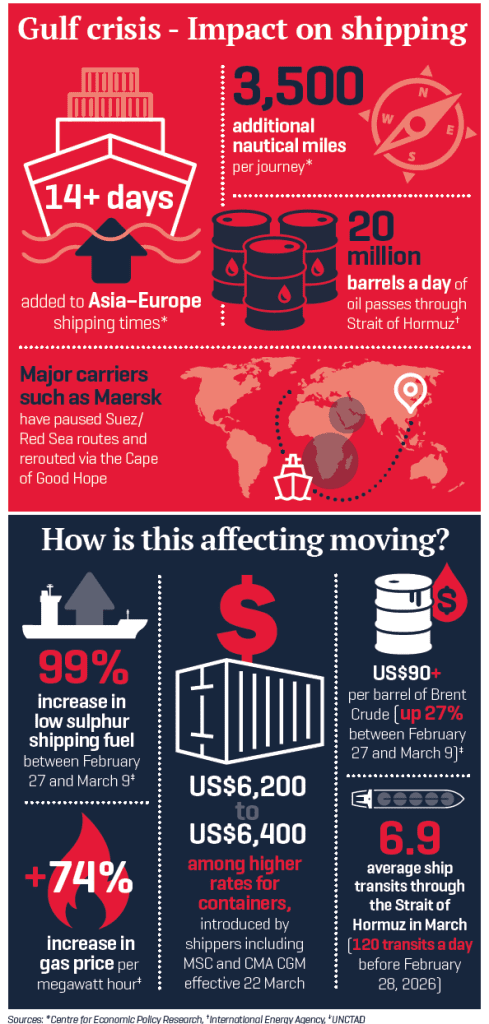
FIDI Focus Conflict Infographic March 31 2026
Since 28 February 2026, heightened tensions in and around the Persian Gulf have significantly disrupted two of the world’s most critical maritime chokepoints: the Strait of Hormuz and the Red Sea.
The Strait of Hormuz is the gateway through which approximately 20 million barrels of oil pass every single day, representing around 20% of global oil supply. Before the crisis began, around 120 ship transits passed through the Strait daily. By March 2026, that figure had fallen to an average of just 6.9 transits per day, a collapse of more than 94% in normal traffic levels, reflecting the severity of the disruption.
In response, major global carriers including Maersk have paused their Suez Canal and Red Sea routes entirely, rerouting vessels via the Cape of Good Hope. This adds approximately 3,500 nautical miles and more than 14 days to Asia-Europe journey times.
What Has Happened to Shipping Costs?

The swift increase in fuel costs and container surcharges represents the most significant cost shock to international shipping since 2024.
The financial impact of the disruption has been swift and severe. Between 27 February and 9 March 2026 alone:
- Low sulphur shipping fuel costs rose 99%, effectively doubling within less than two weeks
- Brent Crude oil prices reached US$90+ per barrel, a 27% increase over the same period
- Gas prices rose 74% per megawatt hour
- Container freight rates reached US$6,200 to US$6,400, among the highest levels seen since the pandemic disruptions, with surcharges implemented by major carriers including Hapag-Lloyd, MSC and CMA CGM effective 22 March 2026
These are not marginal movements. The combination of fuel cost spikes, rerouting surcharges, and reduced carrier availability represents one of the most significant cost shocks to international shipping since the Red Sea disruptions of 2023 and 2024, and the situation continues to develop.
What Does This Mean for International Removals?

Rerouted vessels mean longer journeys, reduced carrier predictability, and potential port congestion for your global relocation.
FIDI Secretary-General Jesse van Sas was direct in his assessment for the international moving industry: “Cost volatility and operational disruption are no longer exceptional events, but factors that need to be anticipated and managed as part of normal business planning.”
For customers planning international moves, the practical implications fall into several categories.
Longer transit times. With major carriers rerouting around the Cape of Good Hope, Asia-Europe shipments are adding 14 or more days to their journeys. This affects not just direct routes but the entire global container ecosystem, as vessels and equipment are displaced across the network.
Higher freight costs. Rising fuel prices and carrier surcharges are translating directly into increased freight rates. Container rates in the US$6,200 to US$6,400 range represent a significant increase from pre-crisis levels, and further adjustments are possible as the situation evolves.
Reduced carrier availability and predictability. With routes suspended and vessels rerouted, the availability of scheduled sailings on specific routes is reduced. This increases the risk of delays at the booking stage and may affect the range of sailing options available for any given destination.
Storage and demurrage implications. Extended transit times can increase the likelihood of port congestion and associated demurrage charges, particularly at busy destination ports. Where moves require intermediate storage, additional costs may arise.
Air freight considerations. Rising energy costs are also affecting air freight pricing, which is relevant for customers moving valuable or time-sensitive items by air rather than sea.
How Is White & Company Responding?

As FAIM-accredited movers, we are exploring flexible scheduling, transparent pricing, and secure UK storage options to protect our customers’ timelines.
As a FIDI Affiliate and FAIM-accredited mover, White & Company is closely monitoring the situation through FIDI’s ongoing updates and through our own operational intelligence across our international partner network.
We are taking the following steps to protect our customers’ moves as effectively as possible.
Proactive communication. We are contacting all customers with active international move bookings to discuss the potential impact on their specific routing and timeline.
Flexible scheduling. Where possible and where it suits our customers, we are exploring alternative sailing schedules, routing options, and booking windows to minimise disruption.
Transparent pricing. We will always communicate any cost changes to customers as clearly and as early as possible, with a full explanation of the underlying causes. We do not impose surcharges without notice or explanation.
Storage solutions. For customers whose timelines are affected, our 19 UK storage facilities, strategically located across the country, provide flexible short and long-term storage options, ensuring your belongings are secure while we work to find the best available shipping solution.
Expert guidance. Our international removals teams have navigated significant global disruptions before, including the 2020 and 2021 pandemic shipping crisis and the 2023 and 2024 Red Sea disruptions. We understand how to manage these complex and changeable situations on behalf of our customers and will continue to do so.
What Should You Do If You Have a Move Planned?

If you’re moving internationally, build additional buffer time into your schedule and review your marine insurance cover (such as MoveProtect).
If you have an international move booked with White & Company, our team will be in touch to discuss the implications for your specific move. If you have any immediate concerns, please do not hesitate to contact your nearest branch directly.
If you are in the early stages of planning an international move, we strongly recommend getting in touch with us sooner rather than later. In disrupted markets, early booking, flexible scheduling, and clear communication with your removals partner make a significant difference to the outcome.
We recommend all customers planning international moves to take the following steps.
Build additional time into your moving timeline. A buffer of several weeks beyond your planned move date is advisable given current transit time uncertainty.
Review your insurance cover. Ensure your items are covered, through White & Company’s MoveProtect service, is appropriate for the value of your belongings, particularly given the potential for extended storage periods during transit.
Stay in contact with your White & Company consultant. We will keep you updated as the situation develops and will always give you the most current picture of what to expect.
The Bigger Picture
The current crisis is a clear illustration of how exposed global logistics, and international removals in particular, have become to geopolitical events. As FIDI’s letter noted, this is not an isolated incident but part of a broader pattern. The 2020 and 2021 pandemic, the 2023 and 2024 Houthi attacks on Red Sea shipping, and now the Gulf crisis have all demonstrated that global supply chains operate in an environment where geopolitical risk must be anticipated and planned for, not treated as exceptional.
This underlines the value of working with an experienced, internationally accredited removal company. White & Company’s membership of FIDI as a founding member means we receive early intelligence on global developments, access to the collective knowledge of the world’s leading movers, and the support of an international network that can adapt to changing conditions. Our FAIM accreditation, which requires rigorous annual auditing against international quality standards, means that our operational processes are built to handle exactly these kinds of challenges.
We will continue to update this page and communicate directly with affected customers as the situation evolves. If you have any questions, our team is here to help.
Frequently Asked Questions
Will the Gulf crisis affect my international move? It depends on your destination and timeline. Moves to and from the Middle East, Asia, Australia, and East Africa are most directly affected by the rerouting of vessels away from the Suez Canal and Strait of Hormuz. European moves by road are less directly affected, though fuel cost increases have some impact on overall costs. Contact your White & Company consultant for a specific assessment of your move.
Will my removal cost increase? The significant rises in fuel costs and container freight rates mean that international shipping costs have increased significantly since late February 2026. White & Company will always communicate any cost implications clearly and transparently. If you have an existing booking, speak to your consultant about what this means for your specific quote.
How long will my international move take? Transit times have increased substantially for sea freight. Moves via routes that previously used the Suez Canal are now subject to detours adding 14 or more days. We will provide you with the most current estimated transit times for your specific destination and routing when you speak to our team.
Where can I find the latest FIDI update? The full FIDI Secretary-General letter and the accompanying infographic of key statistics are available to download directly from the FIDI Focus website.

Max is a seasoned writer and blogger in the real estate and home moving sectors, as well as a knowledgeable source of information for expatriates living and working abroad. His detailed insights have helped thousands of people move and live abroad with greater simplicity and ease.
Posted in: News
Leave a Comment (0) ↓
