
Decluttering Before a House Move: A Room-by-Room Guide That Actually Works

Do you need to start decluttering before a house move, but feel overwhelmed at the thought of it?
If you have ever moved house and spent weeks unpacking boxes only to wonder why on earth you brought half the contents of your old home with you, you are not alone.
Decluttering before moving house is one of the most valuable steps any UK homeowner or renter can take, yet it is consistently the step that gets skipped, rushed, or left far too late.
The logic is simple: every item you do not move is an item you do not pay to transport, do not spend time wrapping, and do not have to find a place for in your new home.
According to removal industry estimates, the average UK household contains between 300,000 and 400,000 individual items.
Even if only a fraction of those belong to you, the sheer volume of possessions most of us accumulate means that a thorough declutter before moving can reduce the size of your removal load significantly, sometimes by as much as a third.
This guide takes a room-by-room approach, helping to take away that overwhelming feeling.
By working through each section at your own pace and setting yourself realistic targets, you will have a leaner, more manageable home to transport by the time moving day arrives.
Pro Tip: Start Eight Weeks Before Moving Day. Most people leave decluttering too late. Beginning eight weeks out gives you time to sell valuable items, arrange charity collections, and make decisions without the pressure of a looming removal van.
A Brief Overview of Decluttering Before a House Move – What This Guide Covers
Moving home is the perfect opportunity to reduce clutter, save money, and start fresh in your new property.
- Before You Begin – Learn the simple three-box method that makes decluttering easier.
- The Kitchen – Clear out unused gadgets, expired food, and duplicate items.
- The Living Room – Reduce books, media, furniture, and everyday clutter.
- The Bedroom – Simplify wardrobes, storage spaces, and unused belongings.
- The Bathroom – Safely dispose of toiletries, medicines, and cleaning products.
- The Home Office or Study – Organise paperwork, technology, and work-related items.
- The Garage, Shed and Loft – Tackle the biggest storage areas and hidden clutter.
- What to Do With Unwanted Items – Sell, donate, recycle, or dispose of items responsibly.
- Decluttering With Children and Family – Tips for keeping everyone involved and motivated.
- Professional Packing Services – Discover how expert packing saves time and stress.
- Your Decluttering Timeline – Follow a practical eight-week plan before moving day.
- Further Reading and Resources – Useful links and tools to support your move.
- Starting Fresh – See why decluttering creates a smoother moving experience.
- Why Choose White & Company – Learn how our removals experts can support your move.
- Frequently Asked Questions – Quick answers to common moving and decluttering queries.
A little preparation before moving day can make settling into your new home faster, easier, and far less stressful.
Before You Begin: The Three-Box Method (And Why It Works)

Discover the power of the “Keep, Donate, Discard” method and learn why “Maybe” boxes are the enemy of a fresh start!
Before you set foot in any single room, give yourself a simple decision framework.
The three-box method has been used by professional organisers for decades because it removes decision paralysis and keeps things moving.
Label three boxes, bags, or zones in each room as follows:
- Keep — This item earns its place in your new home.
- Donate or Sell — It is in good condition but no longer serves you.
- Discard — Broken, expired, incomplete, or genuinely unusable.
Resist the temptation to add a fourth box labelled Maybe or Storage. If an item cannot earn a clear Keep verdict, it almost certainly belongs in one of the other two categories.
Storage boxes that never get opened are one of the primary ways clutter survives to live another day in your new home.
For additional guidance on how to deal with the stress of moving house, The Property Experts has published useful research on why decluttering can reduce stress and improve mental wellbeing during major life transitions such as moving.
Room by Room: The Kitchen

Be ruthless with duplicate utensils, mismatched crockery, and those aspiration gadgets that have gathered dust since 2019.
The kitchen is statistically the most cluttered room in the average British home.
It is also the room where you are most likely to discover duplicates, outdated gadgets, and items that have not been used in the past decade.
Start here and the rest of your declutter journey will feel considerably easier.
What to Tackle in the Kitchen
- Gadgets and appliances: If you have not used them in the past twelve months, question whether they deserve space in your new kitchen. Bread makers, fondue sets, pasta machines, and sandwich toasters are all notorious space occupiers with very low usage rates.
- Expired pantry items: Check every tin, jar, packet, and bottle. Anything past its best-before date goes. Anything close to expiry should be used up or donated to a food bank rather than moved.
- Duplicate utensils and cookware: How many wooden spoons does a kitchen genuinely need? How many spatulas? Reduce to what you actually reach for.
- Chipped, stained, or mismatched crockery: Moving is the perfect moment to invest in a set you actually love rather than transporting the accumulated crockery of multiple households.
- Takeaway menus, instruction manuals, and old receipts: These paper accumulations can be ruthlessly culled. Most manuals are available online, and takeaway menus are redundant in the age of apps.
Donation Idea: UK charity shops such as British Heart Foundation and Oxfam accept kitchen items in good condition. Local food banks will gratefully receive unopened, in-date pantry items.
The Trussell Trust website has a food bank finder for any in-date food items you no longer want.
Room by Room: The Living Room

Move past your lifestyle aspirations and donate the unread books, redundant DVDs, and inherited ornaments you no longer love.
Living rooms tend to harbour what might generously be called lifestyle aspirations: books that will definitely be read one day, DVDs from an era before streaming, ornaments inherited from relatives, and magazines that have been saved for articles that were never revisited.
What to Tackle in the Living Room
- Books: Apply the well-established rule of asking whether a book has been read, whether it will be read again, and whether it holds genuine sentimental value. If it answers no to all three, it can find a new home via a local library, a charity shop, or platforms such as World of Books.
- DVDs, CDs, and physical media: With the dominance of streaming services in UK households, physical media collections are increasingly redundant. Companies such as Music Magpie allow you to sell these items quickly and easily.
- Ornaments and decorative items: Be honest about what you genuinely love versus what has simply always been there. A new home is a fresh canvas, and you do not need to fill it with the same objects by default.
- Furniture: Sofas, armchairs, and coffee tables that do not suit the layout or aesthetic of your new home cost considerable money to transport. Consider selling or donating pieces that will not work in your new space before moving day.
- Cables and electronics: Gather every loose cable and charger and match each one to an active device. Anything unmatched goes.
Room by Room: The Bedroom

Transform your wardrobe by donating clothing that no longer fits, duplicate basics, and occasion wear that hasn’t seen the light of day in five years.
Bedrooms, particularly wardrobes and the notorious under-bed zone, are where sentimental items and forgotten possessions accumulate undisturbed for years. Approach the bedroom with particular honesty.
The Wardrobe Edit
Clothing is consistently the largest category of items that UK residents donate or discard when moving house.
A useful approach is the reverse hanger method: at the start of your declutter, hang all items with the hanger facing backwards.
Over the following weeks, anything you actually wear gets returned with the hanger facing the correct way. Anything still backwards by moving week is a strong candidate for removal.
- Clothing that no longer fits and has not fitted for more than two years.
- Duplicate items in the same category, particularly basics such as t-shirts, jeans, and jumpers
- Shoes in poor condition or that cause discomfort whenever worn.
- Occasion wear that has not been worn in five or more years
- Bedding and towels beyond what is needed for the household’s number of people.
Under the Bed and in Drawers
The under-bed zone deserves its own sweep.
Items stored here often represent things that had no home elsewhere in the property, which is itself a sign they may not be needed.
Similarly, bedroom drawers frequently contain a miscellany of items that were not interesting enough to put away properly but not unwanted enough to throw away.
Now is the time to make those decisions.
Selling Clothes Quickly Before a Move: Platforms such as Vinted, Depop, and eBay let you quickly photograph and list clothing. Local Facebook Marketplace groups are excellent for bundles. Many items can be sold within days if priced reasonably.
While the RSPCA and other animal charities always welcome old towels and bedding.
Room by Room: The Bathroom

Do not pack expired medications! Use up your partial bottles of shampoo and responsibly recycle old beauty products before moving day.
Bathrooms are smaller rooms but can yield a surprising amount of waste. The primary categories to address are toiletries, medicines, and cleaning products.
- Expired medications: These should never be moved to a new property. Return them to any local pharmacy, which is a free and responsible disposal route in the UK.
- Opened toiletries unlikely to be finished: Partial bottles of shampoo, conditioner, and body wash can be used up over the weeks before your move rather than being boxed and transported.
- Duplicate or redundant products: Beauty purchases that were tried once and abandoned, travel-sized products accumulated from hotel stays, and products bought for a specific occasion that has long since passed.
- Cleaning products: These are heavy, awkward to transport safely, and often available very cheaply at your destination. Consider using up what you have and buying fresh at your new address.
Room by Room: The Home Office or Study

Retain your vital financial records and legal deeds, but recycle old tech monitors, redundant reference books, and excess stationery.
For those who work from home or have a dedicated study space, this room can contain both high-value items and remarkable quantities of paper-based clutter.
The arrival of digital documentation has not, for most households, actually reduced the volume of physical paper in circulation.
- Paper files and documents: Retain financial records for six years in line with HMRC guidance, plus any legal documents such as property deeds, wills, and contracts. Everything else can almost certainly be digitised or discarded.
- Old technology: Printers that are no longer used, monitors from previous computer generations, external hard drives that have not been accessed in years. These can be responsibly recycled via your local authority or organisations such as the Restart Project.
- Books and reference materials: Professional reference books that are now superseded, textbooks from courses completed years ago, and trade publications that have accumulated unread.
- Stationery: Most households have far more pens, pencils, notebooks, and assorted stationery than they will ever use. Keep a reasonable working set and donate the rest to a local school.
Room by Room: The Garage, Shed, and Loft
These utility spaces are where objects go when no decision has been made about them.
They represent the largest and most daunting element of decluttering before a house move, and they are also the area with the greatest potential for significant reduction.
Give yourself at least a full weekend for these spaces and approach them methodically, section by section, rather than attempting to tackle everything in one overwhelming session.
The Garage
- Tools: Keep a core toolkit appropriate to your DIY ability and discard anything broken, redundant, or never used. Tool libraries are growing in number across UK towns and cities as an alternative to ownership.
- Sports and hobby equipment: Be realistic about what gets used and what represents a past interest. Bicycles that have not been ridden in years, sports equipment for activities no longer practised, camping gear for trips no longer taken.
- Old paint tins: Dried paint cannot simply be put in household bins. Local authorities and organisations such as Community RePaint accept usable paint for redistribution.
- Seasonal items: Christmas decorations, garden furniture, and seasonal equipment that have not been used for two or more years.
The Loft
Loft spaces have a particular tendency to become the final resting place of things people do not want to decide about. Common loft discoveries include children’s belongings from earlier stages of childhood, furniture that did not fit in previous rooms, and boxes moved from a previous property and never opened since.
If you find a box that has not been opened in more than two years, open it now. If the contents were not missed, they are unlikely to be needed in the future.
Important! Loft Insulation and Structural Items: When clearing loft spaces, note the condition of the insulation and any structural elements. If you are concerned about the condition of your loft insulation, this is a good moment to flag it before the property sale or rental agreement is concluded.
What to Do With Everything You Are Not Taking
A successful declutter generates several categories of outgoing items.
Having a plan for each category in advance prevents items simply being moved from room to bin bag and then abandoned in a corner.
Selling
For items of value, selling is always preferable to discarding. Facebook Marketplace, eBay, Gumtree, and specialist platforms such as Vinted for clothing or Preloved for general household items enable quick private sales.
For larger items such as sofas or appliances, a local collection listing often generates interest within hours.
Donating
Charity shops across the UK accept a wide range of household goods, clothing, books, and small furniture. Many now offer free collection services for larger items.
The British Heart Foundation and Emmaus UK both accept furniture collections. Local community groups on Facebook are also an excellent way to give items away quickly.
Recycling
Your local authority’s household waste and recycling centre will accept a broad range of items that cannot go in a standard bin, including electrical items, large furniture, and garden waste.
Recycle Now provides a comprehensive guide to what can be recycled and where across the UK.
Responsible Disposal
Some items require specialist disposal. Paints, chemicals, and certain electrical items should not go to the landfill.
Your local council website will provide specific guidance for your area. Fly-tipping carries significant fines under UK law and should be avoided entirely.
Decluttering With Children and Family Members

Discover collaborative strategies to get the whole family on board without tears or covert trips to the charity shop!
One of the most common challenges when decluttering before a house move is navigating other people’s possessions and emotional attachments. Children in particular can find decluttering distressing but there are ways to minimise the disruption:
- Involve children in age-appropriate decisions. For younger children, framing the donation of toys as giving them to children who need them more can be genuinely effective. For older children, allowing them to sell items and keep the proceeds creates genuine motivation.
- Give family members advance notice before decluttering shared spaces. Surprises tend to create resistance; involvement tends to create cooperation.
- Avoid making unilateral decisions about a partner’s or parent’s belongings, even when the temptation is strong. A conversation is always more effective than a covert trip to the charity shop.
- If elderly relatives are part of the household move, approach their possessions with particular sensitivity. Items that appear redundant may carry significant emotional weight, and a slower, more collaborative approach is nearly always more effective.
It may be a hundred times easier to just get on with the task in hand; however, a level of sensitivity and patience is required so that you can get everyone on board and lending a hand.
How Professional Packing Services Make the Difference

Once you’ve whittled down to your “Keep” items, let the BAR-accredited experts at White & Company wrap and protect them for a safe journey.
Once you have completed your room-by-room declutter, the items that remain in your Keep category deserve to be transported with genuine care.
This is where professional packing services add exceptional value to a house move.
When a professional packing team handles your belongings, every item is wrapped, protected, and loaded with expertise.
Fragile items are packed with appropriate materials. Artwork is prepared correctly. Appliances are secured. The result is that far fewer items arrive at your new home damaged, and the entire unpacking process becomes faster and less stressful because everything arrives in a logical, organised state.
There is also a time consideration. A professional packing team can complete in a single day what a household might take a week to achieve, often more thoroughly.
For families where both partners work full-time or where children need attention, this time-saving is genuinely significant.
Perhaps most importantly, having a professional packing team handle the final stage of your move means that the decluttering work you have done is honoured.
You have invested time and energy in making thoughtful decisions about what to keep. Having those items packed correctly and transported safely is the natural culmination of that process.
Did You Know?
Research from the removal industry suggests that households that declutter thoroughly before moving report significantly lower stress levels on moving day and greater satisfaction with their new home arrangement in the months that follow.
Your Decluttering Timeline: Eight Weeks to Moving Day
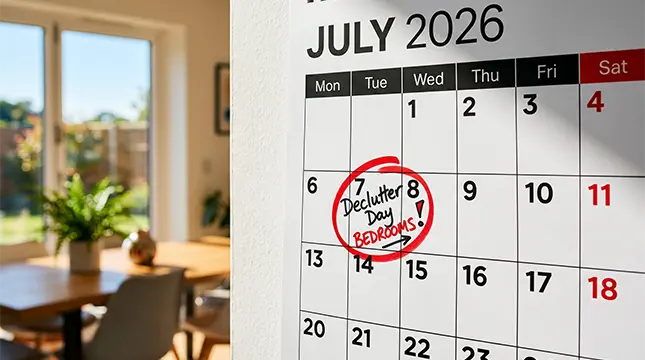
Stay perfectly on track with our week-by-week timeline, ensuring your loft, garage, and bedrooms are completely sorted before the removal van arrives.
To make this process as practical as possible, here is a suggested eight-week timeline for decluttering before a house move.
- Eight weeks out: Begin with the garage, shed, and loft. These take the longest and benefit most from time to sell items.
- Six weeks out: Tackle the living room and home office. List items for sale and arrange charity collections.
- Four weeks out: Complete the kitchen and bathrooms. Dispose of expired items responsibly.
- Three weeks out: Work through bedrooms and wardrobes. Arrange any final collections or tip runs.
- Two weeks out: Final sweep of all rooms. Anything still undecided must now be decided. Confirm packing services.
- One week out: Only items travelling to your new home remain. Begin packing non-essentials or confirm dates with your professional packing team.
Further Reading and Resources
If you would like to explore decluttering methodologies and moving guidance further, the following resources are highly recommended:
- The KonMari Method by Marie Kondo remains one of the most widely adopted approaches to deciding what to keep and what to let go.
- UK: Bulky waste and large item collection gives guidance on arranging council collections for items that cannot go in a standard bin.
- Citizens Advice: Moving home checklist provides a comprehensive overview of what to arrange before, during, and after a house move in the UK.
- Freecycle UK allows you to offer unwanted items to local people at no cost, ensuring useful items stay out of landfill.
Starting Fresh: The Real Reward of Decluttering Before a Move
There is something genuinely satisfying about arriving at a new home with only what you have consciously chosen to bring with you.
The boxes you unpack contain things you genuinely want and need. The rooms you furnish feel intentional rather than arbitrary. The fresh start that a house move promises becomes a fresh start in practice, not just in theory.
Decluttering before moving house in the UK takes time and effort.
It asks you to make decisions that are sometimes emotional and sometimes simply tedious. But the payoff, both on moving day itself and in the weeks and months that follow, is consistently reported by movers as one of the best investments they made in the process.
Begin room by room. Be honest, not ruthless. Give yourself adequate time. And when you are ready for the final stage, trust a professional packing team to handle the things that matter most with the care they deserve.
Consider White & Company for your House Move

Established in 1871, White & Company has grown to become one of the UK’s leading privately owned removals and storage companies.
As a founding member of the British Association of Removers (BAR), including both its Commercial Moving Group and Overseas Group, we are committed to maintaining the highest industry standards.
With 19 branches across the UK, a fleet of more than 265 vehicles, and dedicated in-house moving teams, we complete over 50,000 removals every year.
Whether you’re moving locally, relocating elsewhere in the UK, or embarking on an international move, we provide a tailored service designed around your individual needs.
To find out how we can help get your move underway, call our friendly team or request a free, no-obligation quote online and let us create a moving plan tailored specifically to you.
You can find all our contact details HERE
Frequently Asked Questions
How are removal costs calculated?
Costs are primarily based on factors such as the volume of items, distance between properties, access conditions, and any additional services like packing or storage.
What is the best day of the week to move house?
Fridays are the most popular, which also makes them the busiest and often the most expensive. If you can be flexible, midweek moves tend to be quieter and sometimes more cost effective.
Can a removals company pack everything for me?
Yes, most professional removal companies offer full packing services. This includes carefully wrapping, boxing, and labelling your belongings to reduce the risk of damage and save you time.
When should I start planning my house move?
Ideally, you should start planning at least 6–8 weeks before your moving date. This gives you enough time to book a reputable removals company, gather packing materials, notify utility providers, and organise important paperwork. Leaving it too late often means higher costs, limited availability, and unnecessary stress.
How do I choose the right removals company?
Look for a company that is a member of recognised organisations like the British Association of Removers. Check reviews, ask for a detailed written quote, and confirm what’s included (packing, insurance, storage, etc.). A trustworthy company will also carry out a home survey before giving a final price. Refer to our How to Choose a Removals Company blog for more advice.

Max is a seasoned writer and blogger in the real estate and home moving sectors, as well as a knowledgeable source of information for expatriates living and working abroad. His detailed insights have helped thousands of people move and live abroad with greater simplicity and ease.

Posted in: News
Leave a Comment (0) ↓