
Living in Southsea: An Honest Guide to Life on Portsmouth’s Seafront

Are you relocating and thinking of living in Southsea?
Southsea is the coastal district of Portsmouth, sitting at the southern tip of Portsea Island and stretching from the historic fortifications of Old Portsmouth in the west to the Canoe Lake and eastern seafront in the east.
It is the part of Portsmouth that most people picture when they think of the city, the seafront, the Victorian terraces, the independent cafes on Albert Road, the Victorious Festival crowd on the Common.
For anyone considering a move here in 2026, this guide covers what life in Southsea is like day to day.
A Quick Overview of What to Expect
In this guide, we take an honest look at the everyday realities of life in Portsmouth’s most famous coastal district.
We will explore the practical financial aspects of the 2026 property and rental markets, highlighting the types of homes available and local factors, such as highly competitive school catchments that drive demand.
Beyond housing, we will dive into the lifestyle that makes the area so popular, covering the vibrant independent food and cultural scene, the expansive seafront, and the local transport connections that enable hybrid commuting.
Finally, we will outline the district’s distinct character compared to the rest of Portsea Island, whilst answering the most common questions newcomers have about parking permits, travel times, and daily logistics.
What Kind of Place Is Southsea?
Southsea sits in an interesting position. It is unambiguously part of Portsmouth, the same island, the same postcodes (PO4 and PO5 primarily), the same buses, the same schools, and yet it has a character that feels distinct from the rest of the city.
The seafront and the Common give it a sense of space that the rest of Portsea Island, with its tightly packed Victorian streets, does not always have.
The independent food and culture scene concentrated around Albert Road, Castle Road, and Marmion Road gives it a community feel that holds its own against comparable urban villages in Brighton or Bristol.
The area draws a broad mix of residents. Young professionals are attracted by the period properties and the proximity to the city centre.
Families value the seafront, the open space, and the access to good primary schools.
Students from the University of Portsmouth occupy a significant portion of the rental market. Long-term owner-occupiers, many of whom have lived in the same Victorian terraces for decades, give the neighbourhood its stability and sense of place.
Southsea has a character that holds its own against comparable urban villages in Brighton or Bristol, period properties, independent culture, and two miles of open seafront, all within a city that still offers genuine value for money.
Property in Southsea: What to Expect in 2026
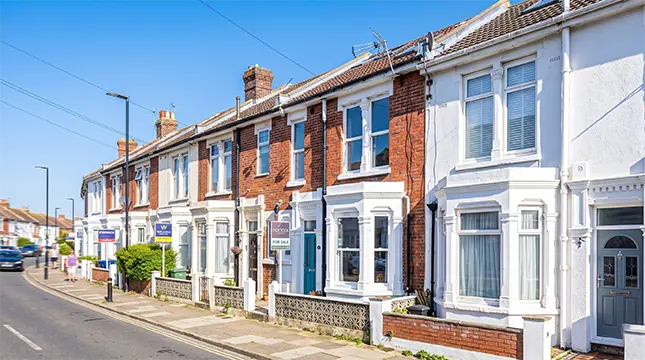
Understand the local housing market where classic Victorian terraced homes average between £220,000 and £320,000, outperforming the broader UK average.
The Southsea property market in 2026 is active and broadly competitive.
The average house price across the area sits at around £208,000 based on Land Registry data, though this figure covers considerable variation.
Victorian terraced houses, which make up the bulk of the housing stock, typically sell in the £220,000 to £320,000 range depending on size, condition, and exact location. Larger period semis and detached properties in the most sought-after streets, particularly around Victoria Grove and The Avenue, command significantly more.
Flats and conversions are plentiful, particularly in the streets running back from the seafront, and represent the entry point for first-time buyers. Conversion flats in original Victorian buildings sell broadly in the £140,000 to £200,000 range for a one or two-bedroom property.
New-build apartments on and around the seafront sit at a premium above this.
The rental market is strong year-round, supported by the student population and the steady flow of naval and professional workers relocating to the Portsmouth area. A two-bedroom house in PO4 or PO5 typically rents in the region of £1,100 to £1,350 per month in 2026. Demand consistently outpaces supply in the better streets.
The school catchment effect
As in much of Portsmouth, school catchment areas have a measurable effect on property values in specific streets. St Jude’s Church of England Primary School in Southsea carries a particularly strong reputation and properties within its catchment attract a layer of buyer interest that pushes values above the immediate local average. It is worth confirming catchment boundaries directly with Portsmouth City Council before making any decisions based on school access.
Schools in Southsea

Chart your family’s academic milestones with top-performing local state options like St Edmund’s Catholic School and prestigious independent academies.
Southsea and the surrounding area is well served by primary and secondary schools, with a broad range available within a short distance of the PO4 and PO5 postcodes.
Primary schools
St Edmund’s Catholic School holds Outstanding status with Ofsted and is one of the strongest-rated schools in the Portsmouth area. Ark Ayrton Primary Academy and Arundel Court Primary Academy and Nursery are both rated Good. Cottage Grove Primary School and Meon Junior School also serve the area with positive Ofsted histories. Parents considering a move to Southsea for access to schools should check the current catchment boundaries and admission criteria directly with Portsmouth City Council and individual schools, as these are subject to annual review.
Secondary schools
Portsmouth High School for Girls, an independent school in the Southsea area, is a popular choice for families seeking selective secondary education. Priory School serves the state secondary market alongside other Portsmouth secondary schools. The University of Portsmouth also contributes significantly to the area’s educational identity and is one of the city’s major employers.
Getting Around from Southsea
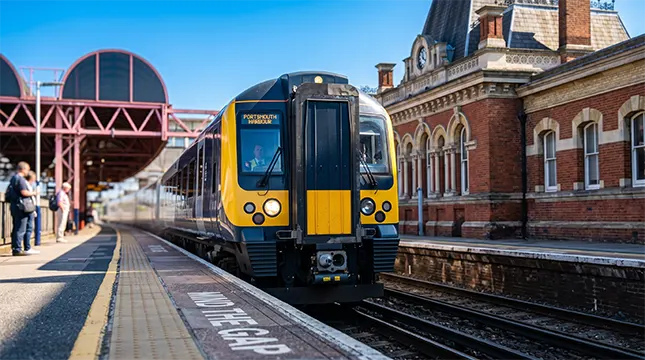
Benefit from a 90-minute direct rail connection to London Waterloo via Portsmouth and Southsea station, making hybrid commuting entirely practical.
Southsea is served by Portsmouth and Southsea railway station, which sits at the northern edge of the Southsea district and provides direct services to London Waterloo via South Western Railway, with journey times of approximately 90 minutes.
Great Western Railway also operates services from Portsmouth Harbour, connecting the city to the west of England via the Havant and Fareham corridor.
For day-to-day travel within Portsmouth, the bus network is comprehensive, and the flat, compact geography of Portsmouth Island makes cycling a genuinely practical option for most journeys.
The seafront promenade is a popular cycle route connecting Southsea to Old Portsmouth and Gunwharf Quays.
Southsea is well placed for drivers heading east or west along the south coast, with the A27 and M27 accessible from the north of the island via the A3 and A2030 routes.
The Gosport Ferry provides a foot passenger link across the harbour for those working on the Gosport peninsula.
Southsea sits around 90 minutes from London Waterloo by direct train, close enough for occasional trips to the capital, far enough to feel genuinely separate from it.
Food, Culture and What to Do

Sample local seafood at The Seafront’s acclaimed restaurant, The Briny, or prepare for the massive crowds at the annual Southsea Food Festival.
Southsea has built a reputation as one of the more interesting places to eat and drink on the south coast. Albert Road is the obvious starting point, an independent high street that runs through the heart of the district, with cafes, restaurants, bars, record shops, vintage clothing shops, and independent bookshops occupying the same stretch that has been gentrified out of existence in many comparable towns.
The dining scene in 2026 spans a wide range. The Briny on the seafront has become one of the most talked-about restaurants in the city for its coastal-focused menu.
Sant Yago on Albert Road brings Spanish tapas to Southsea with a loyal local following. Gunwharf Quays, a short distance from Southsea proper, provides the waterfront dining and retail offer for days when the independent scene is not what you need.
The Southsea Food Festival returns to the town centre on 4 and 5 July 2026 for its 18th year, now part of the Portsmouth 100 programme marking 100 years since the city was granted its charter.
Over 100 food and drink stalls, live music, and the Kitchen Stage on Avenue De Caen make it one of the standout events in the local calendar.
The Victorious Festival takes place on Southsea Common every August bank holiday weekend, drawing major headline acts and tens of thousands of visitors to the seafront.
For the rest of the year, the Kings Theatre on Albert Road and the Guildhall in the city centre provide a consistent programme of theatre, comedy, and live music.
Southsea Castle, a genuine Tudor fortification with sea views across the Solent, is open to visitors throughout the year and is free with a Visit Portsmouth annual pass.
The Seafront and Green Space
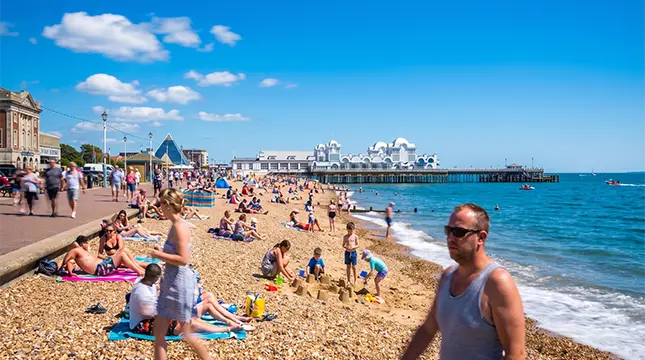
From morning runs across the expansive Southsea Common to family-friendly weekends at Canoe Lake, enjoy unmissable outdoor living spaces right on your doorstep.
The two miles of seafront between Old Portsmouth and Canoe Lake are one of Southsea’s most significant assets. Southsea Common, the large open green space that runs alongside the seafront, provides year-round walking, running, and dog walking without leaving the city.
Canoe Lake at the eastern end of the seafront offers family-friendly recreation and is popular throughout the summer.
The beach itself is shingle rather than sand, but is well used by locals and accessible for swimming throughout the warmer months.
The D-Day Museum, housed on the seafront, covers one of the most significant events in Portsmouth’s history and provides context for the city’s relationship with the Royal Navy and the Armed Forces more broadly.
What Southsea Looks Like Compared to the Rest of Portsmouth
Portsmouth is a compact city built on an island, and the different districts each have a distinct feel. Old Portsmouth to the west of Southsea is quieter, older, and more expensive, a conservation area with a village-like atmosphere.
The city centre around Commercial Road provides the mainstream retail offer. Fratton and North End, further north, are more affordable and family-focused. Milton to the east is quieter and residential.
Southsea sits between Old Portsmouth’s quietness and the city centre’s convenience, offering more character than the retail core and more activity than the eastern residential suburbs.
Ready to Make Your Southsea Move? White & Company Portsmouth Can Help

Whether you are relocating locally to a Victorian terrace near Albert Road or moving to Southsea from further afield, having an experienced team behind you makes all the difference.
Established in 1871 right here in Portsmouth, White & Company has been helping families and professionals move across the Solent area and Hampshire for over 150 years. As proud founder members of the British Association of Removers (BAR), we understand the unique logistics of moving on Portsea Island — from navigating tight coastal streets to managing complex residents’ parking suspensions.
Our dedicated Portsmouth branch offers free, no-obligation home or video surveys, professional packing services, and secure local storage facilities to bridge any gaps in your property chain.
To start planning your seamless move to or from Southsea, contact our local team to request your tailored removals quote.
For most people moving to Portsmouth for the first time, Southsea is the area they have in mind.
Frequently Asked Questions About Living in Southsea
Is Southsea a good place to live?
Yes, for the right person.
The combination of period housing, a genuine independent food and culture scene, two miles of open seafront, and reasonable property prices relative to comparable coastal towns makes Southsea one of the more attractive places to live on the south coast.
The main caveats are parking, Southsea has extensive residents’ parking zones and spaces are competitive, and the density of student rental properties in some streets, which affects the character of those areas.
What are property prices like in Southsea in 2026?
The average house price across Southsea in 2026 is around £208,000 based on Land Registry data. Victorian terraced houses, which make up the majority of the housing stock, typically sell in the £220,000 to £320,000 range. Flat conversions start from around £140,000 for a one-bedroom property. The market is active and well-supported by both owner-occupier and investor demand.
How far is Southsea from London?
Portsmouth and Southsea station is approximately 90 minutes from London Waterloo by direct South Western Railway service. Trains run regularly throughout the day. For drivers, the A3 connects Portsmouth to London via Guildford, with the journey typically taking two hours or more depending on traffic.
Are there good schools in Southsea?
Yes. St Edmund’s Catholic School holds Outstanding status with Ofsted. Ark Ayrton Primary Academy and Arundel Court Primary Academy and Nursery are both rated Good. For secondary education, Portsmouth High School for Girls is a popular independent option. State secondary schools serving the area include Priory School. Catchment boundaries should be confirmed with Portsmouth City Council before making any move decision based on school access.
What is the parking situation in Southsea?
Parking in Southsea is managed through an extensive Residents’ Parking Zone system operated by Portsmouth City Council. Most residential streets require a permit. Demand for permits in the most popular streets exceeds supply, and waiting times can be significant. Anyone planning a move to Southsea should research the specific parking zone for their intended address and understand the permit allocation process before committing.

Max is a seasoned writer and blogger in the real estate and home moving sectors, as well as a knowledgeable source of information for expatriates living and working abroad. His detailed insights have helped thousands of people move and live abroad with greater simplicity and ease.

Posted in: News
Leave a Comment (0) ↓