
Moving to Germany from the UK: Your 2026 Relocation Guide

Thinking about moving to Germany from the UK?
You would not be alone. Germany remains one of the most popular relocation destinations for UK nationals heading to Europe, drawing professionals, families, and retirees in equal measure.
From Berlin’s start-up energy to Bavaria’s beer gardens and the laid-back northern coast, Germany offers a lifestyle to suit almost everyone.
It combines a strong economy, excellent healthcare, and a genuinely high standard of living, while staying within easy reach of home for visits back to the UK.
But before the removal van arrives, there is plenty of paperwork to attend to, including registration, residence permits, health insurance and, if you are not an EU citizen, a visa.
This guide walks you through everything you need to know for a smooth move in 2026, from the moment you land to settling into your new life in Germany.
Planning your relocation? Get a free Germany removals quote from White & Company, trusted by UK families since 1871 for a smooth, stress-free European move.
Essential Guide Highlights
All the points we cover in our Moving to Germany Guide at a glance:
- Why Move to Germany?
Discover why Germany remains a top destination for UK expats, offering strong career prospects, excellent healthcare, and a high quality of life. - Visas, Residence Permits & Registration
Learn about visa requirements, residence permits, and the essential Anmeldung process after arrival. - Finding a Home
Explore Germany’s rental market, buying opportunities, deposits, and what documents you’ll need to secure accommodation. - Cost of Living in Major Cities
Compare living costs in Berlin, Munich, Hamburg, and Frankfurt to help plan your budget. - Jobs and Career Opportunities
Find out where the strongest employment prospects are and how to navigate the German job market. - Healthcare and Insurance
Understand Germany’s healthcare system, insurance options, and how to stay fully covered. - Banking, Tax and Finances
Learn how to open a bank account, manage taxes, and organise your finances after moving. - Education and Childcare
Explore schooling, childcare, universities, and options for families relocating with children. - Transport and Driving
Get familiar with public transport, driving licence exchanges, and getting around Germany. - Language, Integration and Pets
Discover tips for learning German, settling into local life, and bringing your pets with you. - First Week Checklist
A handy summary of the key tasks to complete during your first days in Germany.
With the right preparation and local knowledge, moving to Germany can be a rewarding and uncomplicated experience for UK expats.
Why UK Expats Are Still Choosing Germany in 2026

Strong career prospects and world-class healthcare. Discover why British professionals continue to relocate for opportunities in engineering, finance, and renewable energy.
Germany continues to be one of the UK’s biggest trading partners post Brexit, and its rail network puts Paris, Prague and the Alps within easy weekend reach.
Add world-class healthcare, tuition-free universities, and a growing renewable energy sector, now supplying more than half the country’s electricity, and the appeal becomes obvious.
Around 180,000 British nationals already call Germany home, and roughly 80% of them moved for work rather than retirement, drawn by opportunities in engineering, IT, finance, and academia.
Whether you are chasing Berlin’s creative scene, Munich’s corporate prestige or Hamburg’s maritime charm, each of the country’s 16 federal states offers its own distinct culture and pace of life.
Visas, Anmeldung and Residence Permits in 2026
Your very first hurdle is establishing your legal right to live and work in Germany.
As a UK citizen, you are treated as a third-country national, which means you can enter visa-free for up to 90 days within any 180-day period, but anyone planning to stay longer or take up employment needs a residence permit.
Common routes include the National D Visa, applied for at the German Embassy in London or the Consulate in Edinburgh before you travel, or the EU Blue Card for skilled graduates with a job offer.
For 2026, the general Blue Card salary threshold sits at around €48,300 gross per year, with a reduced threshold for shortage occupations such as STEM, medicine, and IT, typically around €43,800.
These figures are reviewed annually, so always check the current threshold with the embassy before you apply.
Registering Your Address (Anmeldung)
Once you arrive, you must register your address, known as the Anmeldung, at your local Bürgeramt or citizens’ office within two weeks of moving into your new home.
This single step unlocks almost everything else, including your tax ID, health insurance enrolment, and bank account opening, so it should be your top priority.
Book your Anmeldung appointment online as early as possible. Demand for slots in Berlin, Munich, Hamburg, and Frankfurt remains high in 2026, and waiting times of several weeks are common in the larger cities, particularly during the September return to work and school period when relocation activity peaks.
After registering, you will need to apply for your residence permit at your local Ausländerbehörde (immigration office) within the 90-day visa-free window if you have not already secured one through the embassy.
Bring your passport, proof of address, proof of health insurance and, depending on your visa category, evidence of employment or sufficient funds.
For further information, see the German Federal Foreign Office’s official checklist here, and GOV.UK’s guidance for British nationals living in Germany here.
Blocked Accounts and Proof of Funds
If you are applying for a student visa, a job seeker visa or the Opportunity Card, known as the Chancenkarte, you will likely need to open a blocked account, or Sperrkonto, to prove you can support yourself financially while you settle in or search for work.
For 2026, the standard blocked account requirement remains €992 per month, totalling €11,904 for a 12-month visa.
Job Seeker and Opportunity Card applicants face a slightly higher requirement of around €1,091 per month, or €13,092 per year, as they are expected to support themselves without student discounts while seeking employment.
These amounts are set by the German Federal Foreign Office and reviewed annually, so it is worth confirming the exact figure with your embassy before transferring funds.
Reputable providers such as Fintiba and Expatrio allow you to open and fund a blocked account entirely online, usually taking two to four weeks from application to confirmation.
Build this into your moving timeline early since a delayed blocked account is one of the most common causes of visa appointment delays.
Finding a Home: Renting, Buying and Deposits
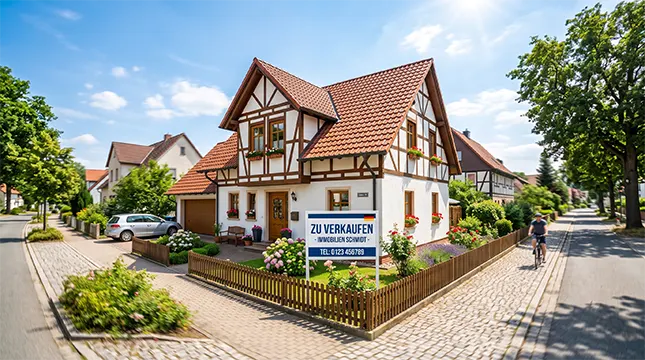
Entering the German property market. Prepare your Schufa credit report and proof of income early to secure a flat in highly competitive city rental markets.
Of course, you will need to find accommodation when you arrive in Germany.
Germany is a nation of renters, like many countries in Europe, with roughly half of all households renting rather than owning, which keeps tenant rights strong and the market well-regulated.
Expect three main costs when renting: Kaltmiete, the basic rent; Nebenkosten, the service charges covering things like building maintenance and waste collection; and a deposit capped by law at three months’ rent.
Bring proof of income, such as three recent payslips, a Schufa credit report, which you can order online, and a copy of your passport to every viewing.
Competition for good flats in the major cities remains fierce in 2026, and landlords often choose between several qualified applicants within days, so having your paperwork ready in advance makes a real difference.
Buying property is also straightforward for foreign nationals. There are no residency restrictions, so even non-EU citizens can purchase a home or investment property outright.
Lenders typically ask for 15 to 20% equity, along with proof of stable income and a clean credit history, but overseas buyers are very much welcome.
Leading portals such as ImmoScout24 let you filter listings by district, price, and energy rating, while estate agents like Engel & Völkers can help with both rental and purchase searches across the country.
Cost of Living: Berlin, Munich, Hamburg, and Frankfurt in 2026

Budgeting for your new European lifestyle. Compare average rental prices across major cities, from affordable districts in Berlin to the premium housing market of Munich.
Overall, consumer prices in Germany remain somewhat lower than in the UK, although the gap has narrowed in recent years and varies considerably by region.
Setting a realistic budget for your destination city will help you settle in with confidence rather than facing unwelcome surprises in your first few months.
Berlin
Berlin remains one of the more affordable major European capitals, although rents have climbed steadily as the city’s population grows.
In 2026, a two-bedroom flat typically costs somewhere between €1,200 and €1,800 per month, depending on the district, with areas like Mitte and Charlottenburg at the upper end and Spandau or Lichtenberg considerably cheaper.
Total monthly living costs for a single person, excluding rent, average around €980 to €1,100.
Munich
Munich consistently ranks as Germany’s most expensive city, driven by a strong economy and a severe housing shortage.
A two-bedroom flat commonly costs €1,600 to €2,200 per month, and rents per square metre are roughly double the national average.
Salaries in Munich tend to be higher to compensate, particularly in the automotive, technology and finance sectors that anchor the local economy.
Hamburg
Hamburg blends coastal charm with strong job prospects in shipping, media, and logistics.
Rents sit below Munich but above the national average, with a typical two-bedroom flat costing €1,300 to €1,900 per month, rising further in sought-after waterfront districts such as HafenCity and Altona.
Frankfurt
As Germany’s financial capital and home to the European Central Bank, Frankfurt carries high housing costs, with two-bedroom flats typically priced between €1,400 and €2,000 per month.
The trade-off is strong earning potential, particularly in banking, finance, and consulting, which helps offset the higher cost of living for many professionals.
Across all four cities, budget an additional €220-€320 per month for utilities in a typical flat, plus about €5 per month for personal liability insurance (Haftpflicht), which is strongly recommended even though it is not legally required.
You should also factor in the mandatory broadcasting fee, Rundfunkbeitrag, currently €18.36 a month, and a mobile SIM plan from around €10.
For up-to-date, city-specific comparisons, Numbeo remains a useful free resource for checking current grocery, transport, and rental figures before you commit to a specific neighbourhood.
Working and Careers: Cracking the German Job Market

Finding employment as a UK expat. Explore highly skilled shortage occupations across the tech and medical sectors where English-speaking professionals are in high demand.
Germany’s labour market remains one of Europe’s strongest, with skill shortages persisting in IT, engineering, healthcare and green technology, all sectors where English-speaking professionals are in real demand.
Unemployment sits at a manageable level nationally, though it varies somewhat by region and sector.
Start your search on the federal portal Make it in Germany, or private job boards such as StepStone.
German CVs typically follow a concise two-page format, accompanied by scanned certificates (Zeugnisse) and, ideally, a professional photograph.
If you earn above the Blue Card threshold mentioned earlier, you may qualify for fast-tracked permanent residency after as little as 21 months, provided you reach B1 level German.
Freelancers, known as Freiberufler, must register separately with the tax office and apply for a residence permit under self-employment rules rather than the standard employment categories.
Healthcare and Insurance: Staying Covered in 2026

Find out whether you qualify for the public scheme (GKV) or if opting for private health insurance (PKV) suits your long-term plans.
Healthcare in Germany is among the best in Europe, and it is mandatory for every resident, whether employed, self-employed or simply settling in for retirement.
The system operates on a dual model, splitting residents between public and private coverage based on income and employment status.
If you earn under the compulsory insurance threshold, which rises to €77,400 a year, or €6,450 a month, from January 2026, you will automatically be enrolled in the public scheme, known as Gesetzliche Krankenversicherung or GKV.
Contributions sit at 14.6% of gross income, plus an average supplementary contribution of around 2.9%, split equally between you and your employer.
If you earn above that threshold, are self-employed, or are a civil servant, you can choose private insurance instead, known as Private Krankenversicherung or PKV.
Private cover can be more affordable while you are young, but premiums climb with age, and switching back to public insurance later becomes difficult after the age of 55, so this is a decision worth thinking through carefully rather than rushing.
Major public insurers include Techniker Krankenkasse, AOK and Barmer. Note that your UK GHIC or old EHIC card will not cover you once you become a resident, so arranging proper local insurance from day one is essential.
Long-term care insurance, Pflegeversicherung, is automatically included at around 3.6%, rising slightly for those over 23 without children.
Once you are settled, register with a local Hausarzt, or GP, as early as possible, since they act as your first point of contact and gatekeeper to specialist referrals via your electronic health card.
Money Matters: Banking, Tax and Pensions

Learn how to open a local bank account, secure your Steuer-ID, and manage your UK state pension from overseas.
Opening a German bank account is straightforward once you have your Anmeldung confirmation.
Digital banks such as N26 offer English-language apps and quick online setup, while traditional branches like Sparkasse remain popular for those who prefer face-to-face banking.
If you need to manage money across both euros and pounds, services like Wise offer competitive exchange rates and multi-currency accounts, which can be useful while you are still settling financial ties back in the UK.
Within a couple of weeks of registering your address, you will receive your Steuer-ID, or tax identification number, by post. Keep this safe since your employer cannot pay you without it.
If you are leaving the UK permanently or for an extended period, submit form P85 to HMRC to avoid being taxed twice, since the UK-Germany Double Taxation Agreement should otherwise take care of the overlap.
UK state pensions can still be paid into your German account without issue.
Private pensions need more thought, and you will need to decide whether to freeze contributions, transfer the pot, or continue paying in voluntarily, depending on your long-term plans and how long you expect to stay abroad.
Education and Childcare: From Kita to University

Explore the differences between local state Grundschule options, subsidised preschool childcare, and British-style international schools.
Moving abroad with children can be a minefield, but it is good to know that Germany takes education seriously and offers excellent options at every stage.
State schools are free and generally high-quality, with children starting at their local Grundschule for years one to four before moving on to a Hauptschule, Realschule, or Gymnasium track based on academic strengths.
Since school places are linked to where you live, your choice of neighbourhood can genuinely shape your child’s education, so it is worth house hunting with catchment areas in mind.
If you would prefer to keep your child on a British-style curriculum, Germany hosts well over 100 international schools offering the IB Diploma or IGCSEs, with fees typically ranging from €8,000 to €23,000 per year.
For younger children, Kita places, Germany’s subsidised preschool childcare, are in high demand, and in cities like Berlin some hours become free once your child turns one. Join the waiting list as soon as you have a due date or a confirmed moving date, since popular Kitas fill up quickly.
Most German universities remain tuition-free even for international students, and many master’s programmes are taught entirely in English, particularly at research powerhouses like TU Munich and RWTH Aachen, making higher education an attractive long-term option for relocating families.
Further information about studying at university can be found on the Deutschland.de website.
Getting Around: Trains, Driving Licences, and the Deutschlandticket

Using public transport across all 16 federal states. Understand how to exchange your UK driving licence for a German Führerschein within your first six months.
Germany’s public transport network remains one of the finest in Europe.
The Deutschlandticket, currently priced at €58 a month, provides unlimited travel on regional trains, buses, trams, and metros across all 16 federal states, making it excellent value for daily commuting or spontaneous weekend trips.
For longer journeys, ICE high-speed trains connect major cities quickly, with early booking fares starting from under €20 if you plan ahead. It remains a wonderfully easy way to explore beyond your new home city once you are settled.
Exchanging Your UK Driving Licence
If you plan to drive, the good news for 2026 is that the UK and Germany maintain a bilateral agreement allowing British licence holders to exchange their UK licence for a German Führerschein without sitting a theory or practical test, since the UK is listed in Annex 11 of Germany’s Driving Licence Regulations.
However, bear in mind that an eye test may still be required as part of the application.
You are legally required to make this exchange within six months of taking up residence in Germany, defined as living there for at least 185 days in a year.
The process typically takes four to six weeks once you submit your documents, and your original UK licence is usually returned to the DVLA as part of the exchange.
Visit your local Führerscheinstelle, or driving licence office, with your passport, proof of registration, a biometric photo, and your current UK licence to get started.
Once you are on the road, remember that cars must pass a TÜV roadworthiness test every two years, winter tyres are mandatory between October and Easter, and many city centres operate low-emission zones, known as Umweltzonen, requiring a green sticker that you can order online in advance.
Fuel currently averages around €1.85 per litre, though private vehicles enjoy toll-free travel on Germany’s famous autobahns.
If you are planning to bring your own car rather than buy locally, our vehicle shipping service can transport it safely to your new German address, taking the stress out of arranging transport and customs paperwork yourself.
Language and Integration: From Hallo to Heimat
While many Germans speak excellent English, especially in larger cities and international companies, daily life, including tax forms, healthcare paperwork and school meetings, still runs predominantly in German.
Investing time in the language early on pays dividends well beyond your first year.
The Goethe Institut offers structured courses through its UK branch from beginner to advanced level, while most local Volkshochschulen, or adult education colleges, run low-cost evening classes once you have arrived, often for around €120 per semester.
Reaching B1 level German genuinely opens doors. It can halve the waiting time for permanent residency and is generally required for citizenship applications further down the line, so it is worth treating language learning as a practical investment rather than an optional extra.
Moving Pets to Germany

Ensure your pet has a valid microchip, rabies vaccination, and an official Animal Health Certificate before crossing the border.
Leaving behind your beloved pet is unthinkable for most people. The good news? Bringing a pet along with you to Germany is entirely manageable with a little preparation.
Dogs, cats, and ferrets travelling from the UK need a microchip, a valid rabies vaccination and an Animal Health Certificate issued by an official vet within ten days of travel, along with an approved travel route and authorised carrier.
Once in Germany, some cities, including Berlin and Munich, require dog registration and an annual dog tax, known as Hundesteuer, and pet liability insurance is mandatory in certain regions, so check with your local registration office shortly after arrival.
For the latest official guidance, see GOV.UK’s pet travel advice and the German Federal Ministry of Food and Agriculture for current rules on travelling with animals.
Your First Week in Germany: A Quick Checklist
The first week after arriving can feel like a blur of administrative tasks, but tackling the essentials early makes everything that follows significantly smoother.
- Register your address, the Anmeldung, at your local Bürgeramt within two weeks of moving in.
- Open a bank account and share your IBAN with your landlord and employer.
- Arrange health insurance and obtain your membership certificate as proof of cover.
- Sort a mobile plan, with providers like Telekom offering unlimited data and free EU roaming.
- Take out personal liability insurance, Haftpflicht, and contents insurance, Hausrat.
- Set up your utilities, choosing an electricity provider and booking recycling bins.
- Join a loyalty programme such as Payback or DeutschlandCard to start saving on your weekly shop.
Being organised really is half the battle. Tackle the paperwork, polish a few useful German phrases, and you will soon discover a country that balances order with genuine warmth and a surprising sense of humour.
Ready to Start Living in Germany?

If you are getting serious about your move, having the right removals partner is non-negotiable.
At White & Company, we have been helping families and individuals move abroad for over 155 years, so we know exactly how to take the stress out of relocating to Europe.
From expert packing at your UK home to handling customs paperwork and delivering door-to-door, our team manages the entire process with care.
Whether you are heading for a bustling German city or a quiet countryside village, we will get your belongings there safely and on time.
Our dedicated removals to Germany service covers full- and part-load shipping, with local offices and storage depots in Germany itself.
If you need somewhere safe to keep your belongings while you find the perfect home, our secure storage solutions give you the breathing space you need, and we will send everything on whenever you are ready.
Planning to take your car with you? Our vehicle shipping service handles the transport and paperwork, so you can simply collect your keys on the other side.
As founding members of the British Association of Removers, and affiliate members of the FIDI and OMNI international relocation networks, we hold ourselves to high standards of service, so you always have someone to turn to if anything does not go to plan.
So, when it is time to plan your big move, let White & Company handle the logistics, leaving you free to look forward to your new life in Germany.
Get in touch, and we can arrange a free, no-obligation survey to discuss exactly how we can get your move to Germany underway.
Frequently Asked Questions About Moving to Germany from the UK
How far in advance should I start planning my move to Germany?
Ideally, begin planning at least three to four months before your intended move date. This gives enough time to apply for your visa if required, open a blocked account if needed, arrange your removals quote and sort housing, all of which can take longer than expected, particularly during busy relocation periods like late summer and early autumn.
Do I need to speak German before I move?
Not necessarily, particularly in larger cities or if you are moving for an English-speaking role. However, even basic conversational German makes daily administrative tasks, healthcare appointments, and social integration considerably easier, and it becomes essential for permanent residency and citizenship applications down the line.
Can I bring my furniture and belongings with me, or should I buy new in Germany?
Most people choose to bring their furniture and personal belongings, since professional removals firms handle the packing, paperwork, and transport for you. It is usually more cost-effective than replacing everything once you arrive, and it helps your new house feel like home far more quickly.
What is the biggest mistake UK movers make when relocating abroad?
Underestimating how long official paperwork takes. Visa appointments, blocked account confirmations, and registration slots can all involve waiting weeks rather than days, especially in popular cities. Starting early and keeping organised copies of every document avoids unnecessary delays.
Should I use a removals company or move my belongings myself?
For international moves, a professional removals company is almost always the more reliable choice. They understand customs requirements, offer insured transport, and can provide storage if your new home is not quite ready, removing a significant amount of stress from an already busy time.

Max is a seasoned writer and blogger in the real estate and home moving sectors, as well as a knowledgeable source of information for expatriates living and working abroad. His detailed insights have helped thousands of people move and live abroad with greater simplicity and ease.

Posted in: News
Leave a Comment (0) ↓