
Self-Storage vs Removals Company Storage: Which is Right for You?

Moving to a new home and struggling with space and needing somewhere to store all your belongings?
Moving house has a funny way of making you realise just how much you own.
Suddenly, there are boxes everywhere, the completion date has shifted, or the new place simply isn’t ready.
Whatever the situation, one question tends to come up pretty quickly: where is all of this actually going?
That’s where the debate between self-storage vs removals company storage really kicks in.
Both options have genuine merit, and both suit different circumstances. The tricky bit is figuring out which one makes the most sense for your particular move.
This guide breaks it all down in plain English, looking at the real differences between the two, what each one costs you in time and money, and when one genuinely wins over the other.
No sales pitch, just the honest facts to help you make the right call.
What This Article Covers
A practical, no-nonsense guide to help UK movers choose between self-storage and storage with a removals company.
- The two options explained — what self-storage and managed removals storage actually involve day-to-day.
- Cost comparison — why the headline price isn’t always the full picture.
- Physical effort — who does the heavy lifting and why it matters.
- Access and flexibility — how often you can get to your belongings with each option.
- Security — how each type of storage keeps your possessions safe.
- Insurance — what your home policy may or may not cover in storage.
- Duration — which option suits short-term vs longer-term needs
- When self-storage wins — the situations where a self-storage unit is the smarter call.
- When removals storage wins — the scenarios where professionally managed storage makes more sense.
- FAQs — six common questions answered on vehicles, insurance, access, prohibited items and international storage.
Whether you’re weeks away from moving day or still in the planning stage, this guide gives you the facts to make the right storage decision.
The Two Options at a Glance
Before diving into the finer details, it helps to understand what each type of storage actually involves day to day.
With self-storage, you hire a unit at a purpose-built facility, pack your own belongings, transport them there yourself, and come and go as you please.
Companies like Safestore and Big Yellow Storage operate this way across the UK, giving you a padlocked room that is yours to fill and access at will.
Removals company storage works rather differently.
A professional team collects your items, wraps and loads them carefully, and places them in a managed facility on your behalf.
White & Company’s secure storage solutions operate this way, meaning you never have to hire a van, wrestle furniture down a staircase, or worry about who has access to your possessions.
According to the SSA UK and Cushman & Wakefield Annual Industry Report, 40% of domestic self-storage customers in Britain are using their unit during a house move, which tells you there is strong demand on both sides of this argument.
Counting the Real Cost

Pricing is usually the first thing people look at, but the headline figure doesn’t always tell the full story.
Self-storage tends to advertise low weekly rates, and that can feel reassuring at first glance. But factor in the cost of renting a van, buying packing materials, taking time off work to move things yourself, and purchasing adequate contents insurance, and the total starts to climb.
The Money Advice Service recommends building a full budget before committing to any storage arrangement, including transport, insurance, and access trips, not just the monthly unit fee.
Removals company storage often includes transit, professional packing, and storage cover within a single quote. That joined-up pricing can work out more economical than it first appears, particularly for longer stays or larger volumes.
If you’re also booking a full house move, combining both services with one provider can sometimes unlock discounted rates. It doesn’t hurt to ask!
It is always worth asking for a detailed breakdown on both sides before deciding.
There is a useful cost guide over at Which? Moving Home that covers what a typical storage arrangement should and shouldn’t include.
Who Does the Heavy Lifting?
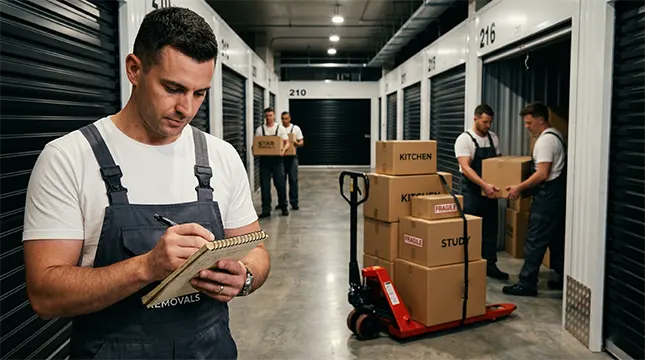
One of the most overlooked differences between these two options is the sheer physical effort involved.
Self-storage puts you firmly in charge of everything. That means loading, carrying, and unloading your belongings using your own steam or roping in willing friends and family.
For a studio flat or a handful of boxes, that’s perfectly manageable. For a three-bedroom house with a piano in the front room, it’s quite another matter.
When you use a removals firm’s storage service, the heavy work is handed to trained professionals. The team arrives, assesses what needs moving, wraps fragile items properly, and takes care of the full physical process from doorstep to depot.
Those who have used White & Company’s house removals service alongside storage often cite the removal of physical stress as one of the biggest benefits.
Organisations like the NHS Moving Home guidance highlight that back injuries from improper lifting are extremely common during house moves.
Having professionals handle the load reduces that risk considerably, particularly for older movers or anyone with physical limitations.
Access, Flexibility and Who’s in Control
How often you need to get to your belongings can be the deciding factor for many people.
Self-storage wins hands down on access. Most facilities are open seven days a week, sometimes around the clock, so you can pop in to grab your winter coats or retrieve a document without any prior arrangement.
That level of flexibility suits people who are in the middle of a phased move or running a small business from their unit.
Removals storage is a different proposition. Your items are professionally warehoused, often in containers or on pallets, and retrieving specific items requires advance booking.
It suits those who need everything taken care of in one go and aren’t expecting to dip in and out regularly during the storage period.
The HomeOwners Alliance also offers good impartial advice on managing the gap between exchange and completion.
Keeping Your Things Safe

Whether you’re storing antiques, electronics, or everyday furniture, security is something you really can’t afford to overlook.
Reputable self-storage facilities generally provide CCTV, individual unit alarms, and on-site security personnel.
You control your own padlock, which means nobody can enter your unit without your key. That said, the quality of security genuinely varies between providers, so it pays to visit the site before signing anything.
Removals company storage facilities tend to operate as managed warehouses with access restricted to staff only. Your items are usually stored in sealed, numbered containers.
This limits the number of people who can physically reach your possessions, which many customers find reassuring. Additionally, at White & Company, all our facilities are locked, and security cameras monitor the premises 24hours per day.
The British Association of Removers, of which White & Company is a proud member, sets industry standards for storage handling and security protocols.
BAR members are independently vetted and must adhere to a strict Code of Practice, giving customers an added layer of confidence.
The Consumer Rights Act 2015 also gives you statutory protection if goods in storage are damaged or lost.
What About Insurance?
Insurance is one of those things that feels tedious to sort out until you actually need it.
With self-storage, contents insurance is rarely included as standard. You may be able to add it through the facility for an extra cost, or your home insurance policy might cover goods in storage.
It is absolutely worth checking the small print before assuming you’re protected.
When using a removals company for storage, cover is often built into the agreement or offered as a straightforward optional add-on to arrange.
White & Company’s packing solutions include wrapping and protection measures that reduce the risk of damage in the first place, which is arguably just as important as the insurance itself.
Here again, it is worth asking about liability cover before you store your belongings, whether with a self-store or your removal company.
How Long Are You Planning to Store?

Duration matters more than most people expect when weighing up the two approaches.
For short-term storage of a few weeks, self-storage can be very competitive. You pay for exactly the time you use, units are available quickly, and you can vacate at short notice. It suits those in between moves who just need a temporary overflow solution while everything is being sorted.
For anything beyond a month or two, particularly when storage runs alongside a longer-distance or international relocation, removals company storage often becomes the more practical choice.
The professional handling is especially valuable when goods need to remain undisturbed for several months.
White & Company handles storage for customers at every stage of the journey, whether it’s a few weeks between properties or a longer arrangement while relocating abroad.
Their long-distance removals service and international moving service both integrate with storage options to make the entire process as joined-up as possible.
When Self Storage Makes Sense
There are plenty of situations where self-storage really is the smartest call.
If you’re decluttering before putting your home on the market, self-storage offers a quick, flexible place to move surplus furniture and clear the space. It works particularly well when you’re at the early stages of planning and not yet ready to book a removals team.
Small business owners, online sellers, and tradespeople often use self-storage as a practical solution for storing stock, tools, and equipment, or for archiving documentation.
The Self Storage Association UK’s annual report confirms that small businesses make up a significant share of storage customers, with the vast majority being micro-businesses — many of them sole traders who’ve simply run out of room at home.
The Federation of Small Businesses highlights storage as a common first step for growing sole traders who have outgrown working from home.
For a straightforward one-bedroom move where you’re doing much of the work yourself and timing is flexible, self-storage keeps things simple and affordable.
Rightmove’s preparing-to-move guide specifically mentions storage as part of the moving process.
When Removals Company Storage Is the Smarter Choice
There are times when handing the whole thing over to the professionals just makes life considerably easier.
If you’re moving a full family home, especially one with large furniture, fragile pieces, or a significant volume of possessions, a removals company’s storage eliminates the logistical headache of multiple van trips and manual loading. Everything is collected in a single visit and returned when you’re ready.
It’s also the obvious choice when your move involves a long-distance element.
Anyone relocating from one end of the country to the other or heading overseas benefits from having a single trusted company manage both transport and interim storage.
White & Company’s European removals service frequently combines transit and storage for customers in exactly this position.
Corporate relocations almost always involve professional storage management, too.
If your employer is covering the cost or coordinating through an agent, removals company storage is typically expected.
The White & Company corporate relocation service is designed with exactly this kind of scenario in mind.
Ready to Move? White & Company Are Here to Help
White & Company has been helping families, individuals, and businesses move with confidence since 1871.
With 19 branches across the UK and Channel Islands, we offer a comprehensive range of secure storage solutions, from short-term interim storage to long-term managed warehousing.
As proud members of the British Association of Removers (BAR), White & Company work to a strict Code of Practice, giving you real peace of mind that your belongings are in safe, professional hands.
Whether you’re moving locally or internationally, we can tailor a storage solution around your specific timeline and needs.
To find out more or get a personalised quote, use our online quote form to get things moving today.
Frequently Asked Questions
A few common questions from people planning a move and thinking about storage options.
Can I store a car or motorbike in a self-storage unit?
Some self-storage facilities do offer vehicle storage, though not all units are suitable for cars or larger vehicles. You would typically need a ground-floor drive-up unit with the right dimensions. It is always worth asking the facility directly before assuming your vehicle will fit and that it is permitted under their terms.
What happens to my belongings if a removals company goes out of business during storage?
This is a concern worth taking seriously. Choosing a removals company that is a member of the British Association of Removers provides a degree of protection, as BAR members operate under a Code of Practice and dispute resolution scheme. You should also check that any storage agreement outlines what happens to your goods in the event of business continuity issues.
Do I need to tell my home insurer that my belongings are in storage?
Yes, in most cases you should inform your insurer. Many home insurance policies have conditions around property kept away from your main residence, and failing to disclose this could invalidate a claim. It is always worth calling your insurer to confirm what your current policy covers and whether an extension is needed.
How much notice do I need to give to access items stored with a removals company?
This varies between providers, but most removals companies ask for 24 to 48 hours’ notice to arrange access to warehoused goods. If you think you will need to retrieve specific items regularly during the storage period, it may be worth discussing a more flexible arrangement at the point of booking or considering self-storage instead.
Are there things I cannot put into storage, either self-storage or removals?
Yes. Both types of storage have prohibited items lists that typically include hazardous materials, flammable substances, perishable food, plants, and anything illegal. Removals companies will usually provide a detailed list at the point of booking. If you are in any doubt about whether a particular item can be stored, always ask before it ends up in the van.
Is it possible to store items overseas if I am moving internationally?
Yes, international storage arrangements are available through specialist removals companies. If you are shipping goods to another country but they need to be held temporarily either before departure or on arrival, a removals firm with international experience can manage that on your behalf. This is a common part of a longer relocation project and worth discussing at the quoting stage.

Max is a seasoned writer and blogger in the real estate and home moving sectors, as well as a knowledgeable source of information for expatriates living and working abroad. His detailed insights have helped thousands of people move and live abroad with greater simplicity and ease.

Posted in: News
Leave a Comment (0) ↓